Would You Sell Your Soul?
The Story
Welcome tothe podcast!! If you enjoy the work, consider buying me a coffee!!
https://buymeacoffee.com/kobecooman3
This is a public episode. If you'd like to discuss this with other subscribers or get access to bonus episodes, visit kobione.substack.com/subscribe
SPEAKER_01: Some men would gladly die, give up their life for a chance at greatness. So what if you already know your life will be taken from you and you haven't reached that greatness yet? Would you call upon the devil and give up more than your life alone? Hermann decided that yes. Earthly greatness was worth your eternal soul, and so came about the creation of the Codex Hygas. Try this one on for size, but be careful, it's definitely extra extra large.
SPEAKER_01: You are listening to the Kobi One podcast, a new article out every Sunday. You can find them on Substack, Kobi One, or listen to them wherever you get your podcasts.
SPEAKER_01: The Codex Hygas can be found today in the National Library of Sweden, Stockholm. It weighs 74 kilograms.
SPEAKER_01: For the pages, a good 320 of them, 160 skins, donkey skins, were used.
SPEAKER_01: To be able to open this book, you need two people at the least. According to modern calculations, it would have taken one man between 25 to 30 years to create. Yet, the myth surrounding its creation begs to differ.
SPEAKER_01: Herman the recluse was a monk who had broken his vows and would see punishment in its most narrow of ways. Immurement. Literally walling somebody up. They would be walled into a cell with a window for light to read by and receive food by. They could stand, kneel, pray or lie down. They got to read and eat. Herman would never write again. So he makes a deal with the abbot. Give him one extra night wherein he would produce a book of such grandeur it would give honor and respect to the monastery for all eternity.
SPEAKER_01: As morning approached the book was nowhere near finished. Herman makes a deal with somebody else. The devil namely. By the time Hermann and the devil were through, the book contained close to all important knowledge of the day, which was around the 13th century.
SPEAKER_01: The Complete Latin Vulgate Bible, both Old and New Testament, Josephus, Antiquities of the Jews, Josephus, the Jewish War, Isidore of Sevis, Encyclopedia Etymologiae, something, oh God, The Chronicle of Bohemia by Cosmas of Prague, A Calendar, Medical Texts,
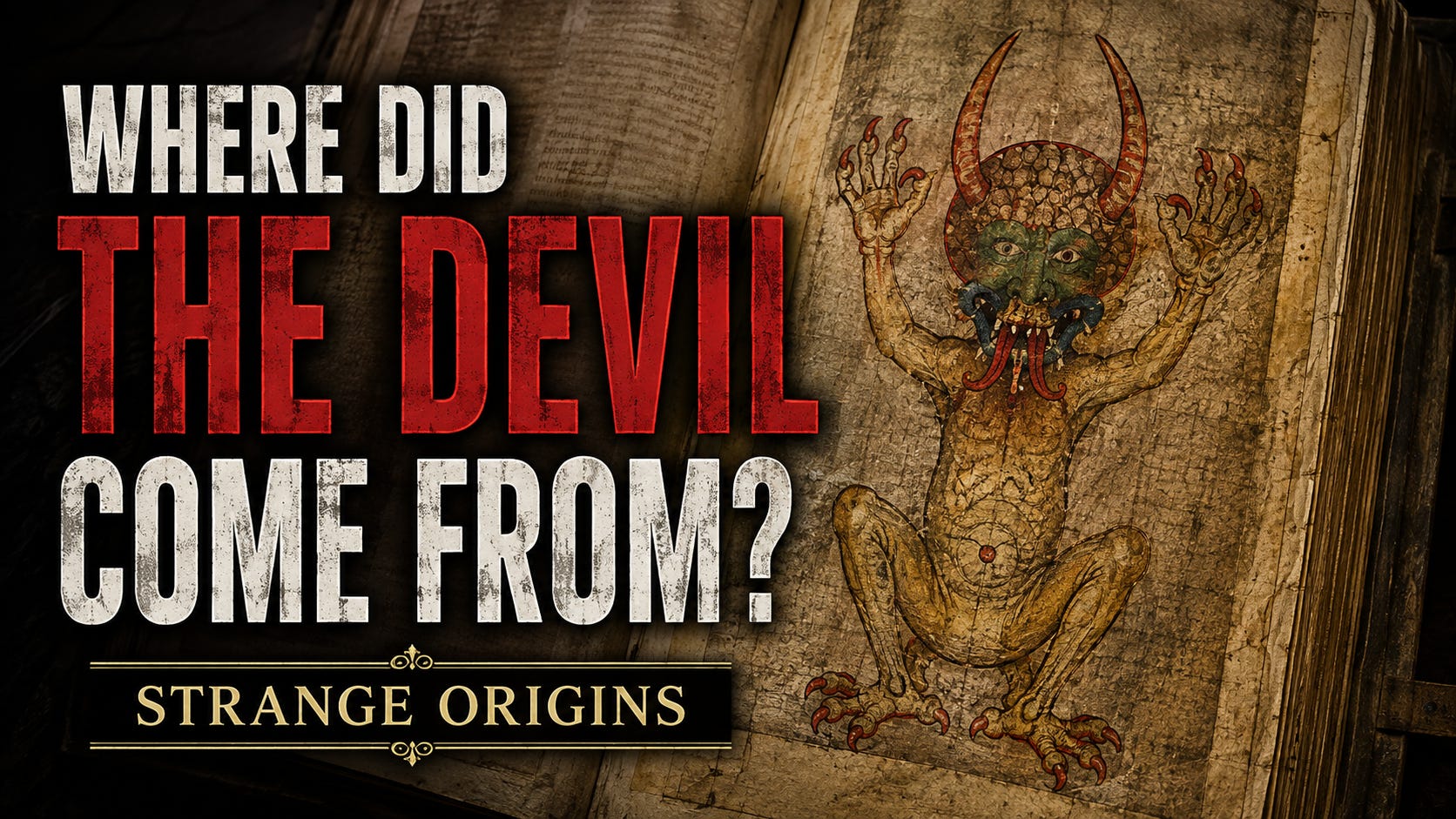
SPEAKER_01: A guide to exorcisms A list of the brothers of the Podlatsitz Monastery Various shorter texts on topics including alphabets and other reference material and, ever more remarkable, the only known full-length medieval portrait of the devil himself on page 290 and the heavenly city depicted on the facing page. What is missing? Ten to twelve pages Containing information too dangerous to be allowed to roam freely. Hermann makes a deal with the devil and leaves the only known full-length medieval portrait of said devil in his contemporary shape as a thank you note.
SPEAKER_01: Now, all of what you just read is most likely nothing but a myth. The reality is, I think, almost more unbelievable. One of the details that made so many people believe this myth, even though no original source Nobody could believe it.
SPEAKER_01: And that might be one of the saddest things afflicting modern man, our incapacity to believe that civilizations before us were capable of feats of such grandeur they outshine both our personal achievements as our collective achievements. The pyramids were built by aliens, the Codex Gigas was written by the devil, and even Robert Johnson, the famous blues guitarist, had to sell his soul to be able to play the guitar that well. There is a pattern here. Mankind, or one of its representatives, achieves greatness, and years later, the devil, or occasionally other potential culprits, run off with the honor.
SPEAKER_01: So too it was with the missing pages containing the information too dangerous to be released. They probably never existed neither. The more likely explanation there is that they contained the Benedictine rule, the code of conduct governing monastic life, removed quietly when the manuscript changed hands between monasteries. Yet, once more, the devil claiming his prize after the facts.
SPEAKER_01: One of the first mentions of a devil-like persona is the Hebrew HaSatan, which means something along the lines of the accuser or adversary.
SPEAKER_01: Ha! Does not function as something comical. It functions as a role or job description without actually naming the entity. His job was close to modern-day prosecutors, but by godly employ. In the book of Job, he is the one, Hasatan, who is tasked by God to test Job's righteousness. Hasatan was not perpendicular to or in contrast with God. No dichotomy between good and evil. The ancient Hebrew texts portray more of a holistic way of viewing religion. God is all. Good and evil are but manifestations of the same divinity.
SPEAKER_01: And then the Jews were taken into Babylon. When Cyrus the Great, the great Persian ruler, went on his rampage of quite epic proportions and vanquished the Lydian kingdom in the west, he stretched out his empire all the way till the shores of the Aegean Sea. All that now stood before him was the colossal power of the Neo-Babylonian Empire, the head of the snake, the main force behind the Mesopotamian civilization. You might remember the Mesopotamians from gifting us the world's oldest customer complaint in cuneiform tablets.
SPEAKER_01: Imagine being immortalized as that guy that sold low-quality-ish back in the day. Whoopsie. But I digress. The Persians start getting pretty biblical on the Babylonians and install Persian rule and Zoroastrianism, which has nothing to do with Antonio Banderas in a mask, mind you. The captive Jews spend fifty years under Zoroastrian rule, And the Tanakh starts incorporating things such as Zoroastrian Ahurumazda, pure good, and Ariman, pure evil. Ideas such as cosmic dualism, free will, final judgment, heaven, and hell were not featured in Hebrew texts until the confluence between the Jews and the Persians occurred in Old Babylon.
SPEAKER_01: God's persecutor becomes a representative of the dark side. The split between good and evil came through conquest, war and blood. How very fitting.
SPEAKER_00: Lucifer son of the morning, I'm gonna chase you out of earth.
SPEAKER_01: The origins for the term Lucifer is one of the world's oldest recorded burns. It was actually a political poem, which sounds mutually exclusive to me, though, marking the king of Babylon. Soon as he rose to power, he lost his empire to the Persians, hence the name Hillel ben Shachar,
SPEAKER_01: Shining One Son of the Dawn T'was a poetic reference to the morning star Venus, which rises brilliantly, only to disappear short after, at sunrise. The king of Babylon, too, rose to power quickly and brilliantly, and he, too, fell just as quickly. From Hebrew to Greek to Latin, the concept and description was handed down and translated manyfold times. The translations stayed quite accurate across many generations and languages until the chroniclers of the New Testament. They started using the image of a star falling from heaven as a metaphor for Satan's expulsion, connecting it to the passage of Isaiah in the Bible.
SPEAKER_01: Lucifer was Latin for morning star or light bearer and was thusly connected to Venus. In other words, Lucifer was still a wink towards the fallen Babylonian king. Early Christians then started associating this roast on a king who rose brilliantly and fell with the falling of that angel we came to know as Satan, or now also Lucifer. It was a misattribution, but it stuck. Milton's poem reads like a Greek
SPEAKER_01: Epic wherein the devil takes the place of the hero, or better yet, the anti-hero. The poem depicts Satan's fall from heaven and subsequent journey and struggles. We find Satan traversing the boundless deep and facing many adversaries, amongst others, the main men themselves, God, and even death. The opinions here differ. There are some claiming that the framing of Satan as the protagonist in this 17th century hero's journey gives way to sympathy for the devil. There is others who view this as Milton saying that if even Satan can be personified into a hero, maybe our view on what a hero entails is wrong and should be re-examined.
SPEAKER_01: With a writer this great, I am tempted to believe that, his personal belief system aside, he just found a great story and ran with it, whichever direction it would lead to. Until now, there wasn't a whole lot of POVs on Satan's journey. I will use Dante as contrast. In Dante's Inferno, Satan is a large, looming monster that feels more mechanical than anything else. He is purely one side of the godly coin. There is no personality to it. Milton's Lucifer, however, now he is overflowing with personality.
SPEAKER_01: Dynamic, charismatic, easily liked even. This is supposedly fuel for the Milton-loved-Satan argument. I personally believe once more that Milton... He says,
SPEAKER_01: Milton actually understood evil to be different from Dante's description. Hell does not feel evil in Dante's world, it just is. It's part of the universe in which they or we roam. Milton's is more malevolent. Evil perpetrated by somebody we can sympathize with lies, as an idea at least, much closer to the actual reality of evil.
SPEAKER_01: Like so often with the Catholic Church, its inspiration was almost entirely drawn from the civilizations they were conquering and assimilating, just like the Romans did with Greek gods and somewhat like the Assyrians did to everyone around them. Though the Assyrian version was way cooler. I might one day write on these civilizations, but there is already an abundance of good podcasts out there, so I will just say that the way they tackled competing civilizations and their respective gods was simply wild.
SPEAKER_01: Even their capital city became an actual deity. I recommend you check out, for instance, History Time or The Fall of Civilizations if I had your interest here piqued. The modern day devil? He's mostly a Frankenstein's monster of pagan gods such as Pan and the Satyrs, all horns and cloven hooves. His red complexion can be traced back to Roman Mars, and the pitchfork has Poseidon written all over it. The devil makes his first appearance in his more or less current form in the very Codex Gigas discussed here above.
SPEAKER_01: The fact that on the facing page the heavenly city is depicted is of course not random. This dichotomy between good and evil would become Catholic lore. Nothing showcases this more beautifully than Bosch's painting The Earthly Delights. I will paraphrase and transcribe some passages on the painting from the book Onboss by Stefan Fischer.
SPEAKER_01: Boss's Hell Panel, the right wing of the Garden of Earthly Delights, circa 1503, is built around a brutal irony. The instruments of pleasure become the instruments of punishment. As the book's author puts it, the figures tormented here are souls who in life bombarded others with their more gigantesque music. The joke being one of scale and inversion Where heaven gets harps and choirs Bosses damned get the same instruments turned into machinery of torture The instruments themselves carry a hierarchy of shame.
SPEAKER_01: The author notes that alongside the major instruments, Boss includes the lower kind too, drum, harp, lute, vielle and bagpipe, instruments tied to the disreputable vilaine auberge, itself a recurring symbol of music's links to lechery and disorder. The body becomes the instrument. One of the most striking moves the book describes is how Boss fuses anatomy and instrument. Bodies and music literally interpenetrate so that being played and being tortured are the same act. The text draws a direct line to scripture here, citing Matthew 5, 27-30.
SPEAKER_01: The, if your right eye causes you to sin, tear it out passage. As the likely source for the mutilation imagery, severed limbs and organs standing in for the castration as punishment, tradition associated with adultery in medieval thoughts.
SPEAKER_01: The general thesis put forward by Boss, it seems to me, is that within music it is as in within man. There exists good and evil, and they both exist as polar opposites on the spectrum of morality. You can position all instruments along the circle of godliness and assess its piety. Some instruments are holier than others. In my last Strange Origins, before this one, I propose that man installed God's time in church towers through bells and accidentally left the doors open. Time escapes and distorts into music, thusly inviting the devil to join the party.
SPEAKER_01: It seems Boss would have agreed. I just think we might have differed in musical preferences. If he thought the lute belonged in hell, I wonder what he would have thought of my band.
SPEAKER_01: Boss put all lesser instruments, according to him at least, and their players in hell to be tormented forever. Ever since then,
SPEAKER_01: Or who knows for how long really Satan and music have been linked and rocking out together. Take for instance the Diabolus in Musica which is a tritone interval that was banned from medieval church music because it was literally considered to contain the devil himself. It had not been banned from pop music, however. It is the opening interval of Black Sabbath's first song. When searched, it can be found in Hendrix 2, West Side Story, The Simpsons theme, the list is quite long really. And then there is that quite diabolical looking man, knighted by Queen, a lizard beast herself, Mick Jagger, and his song Sympathy for the Devil.
SPEAKER_01: He wrote it after finishing the book Master and Margarita, written by Bulgakov. When the devil himself arrives in Stalinist Moscow as a charming professor. And lest we forget the OG soul-selling myth mentioned above, Robert Johnson, a man fabled to have been around musicians all the time but not knowing how to play, disappearing for some time and then returning as one of the most talented, quick-fingered, blues guitarists of his time.
SPEAKER_01: Once more, posthumously, this was explained by the man selling his soul to the devil at a crossroads. There ain't no thing like practice makes perfect, just draw that pentagram already. I think I've managed to make my point. Satan and music were a match made in heaven. Since the devil has been claiming almost all that was contrarian or just simply hard to swallow or difficult to believe, he and the esoteric and mystic symbols often linked to him have just been Overflowing in all art forms and often remarked upon by conspiracy theorists that dabble in the occult.
SPEAKER_01: The all-seeing eye, the pyramid 666, etc. Most of this can actually be attributed to one man that is silently adored by many famous artists throughout modern time and that died as a poor, heroin-addicted man in the suburbs of England. Alistair Crowley That was, however, not his original name, but a name chosen on its numerical qualities, a name purposefully chosen for fame. It seems to have worked. Crawley wrote many books and was a member of almost every The music and art scene are riddled with references to this man.
SPEAKER_01: A few of the more commonly known examples...
SPEAKER_01: The Beatles put Alistair Crawley's face on the Sgt. Pepper cover. Led Zeppelin, well, one of them, Page, he buys Crawley's bowl-skin house on Loch Ness, a house where a lot of crazy stuff went down when Alistair Crawley himself was there. Then David Bowie, he paraphrases Crawley's 1923 poem in the famous song Let's Dance. Then there's Jay-Z who publicly wore a hoodie saying do what thou wilt and whose rockwear line has the eye of Horus. After 2000 years of accidental yet elaborate construction, the devil has been transformed from a burn on a Babylonian king into a contracted hype guy for artists.
SPEAKER_01: In the meantime, taking many forms and claiming many prizes for grand achievements on the back of mankind's endeavors.
SPEAKER_01: Persian theology A Hebrew job title A mistranslated Babylonian taunt Greek god's body parts One monk's midnight bargain A Flemish painter's hell panel Not to mention all folkloric myth Like the Venetian grandmother's folk tale Which you might want to look for and read for yourself Very amusing The devil, he did it all. That is why, in Flemish, you call a jack-of-all-trades, a devil who does all, unduiveltje doet all. One of Ghent's most famous knights, Gerard Villain, a.k.a. Gerard the Devil, he potentially earned his nickname thusly.
SPEAKER_01: It might also have something to do with him killing his father for not wanting to go on the crusades, and then kicking his wife to death in a drunken rage after she had birthed a child of a complexion much too black for Gerhard's taste. Pictures of his epic castle, still to visit until today, attached just underneath in the Substack version. I will make an account of this man and his castle in my soon-to-be-released Ghent Unguided PDF.
SPEAKER_01: Thousands of years of running amok and claiming human achievements as his own has made the devil into a template for coolness. You wanna be cool? Put some damn sixes in there and make sure you close one eye. The devil will get you famous. To me, it seems the devil got whipped.
SPEAKER_01: You have been listening to the Kobi One Podcast. Now, what the devil are you still doing here? Go on. Go and see if I didn't release a new one just yet. I'll see you there.
 Apple Podcasts
 Castbox
 Castro
 Goodpods
 Moon FM
 Overcast
 Pocket Casts
 Podbean
 Podcast Addict
 Podcast Republic
 Spotify