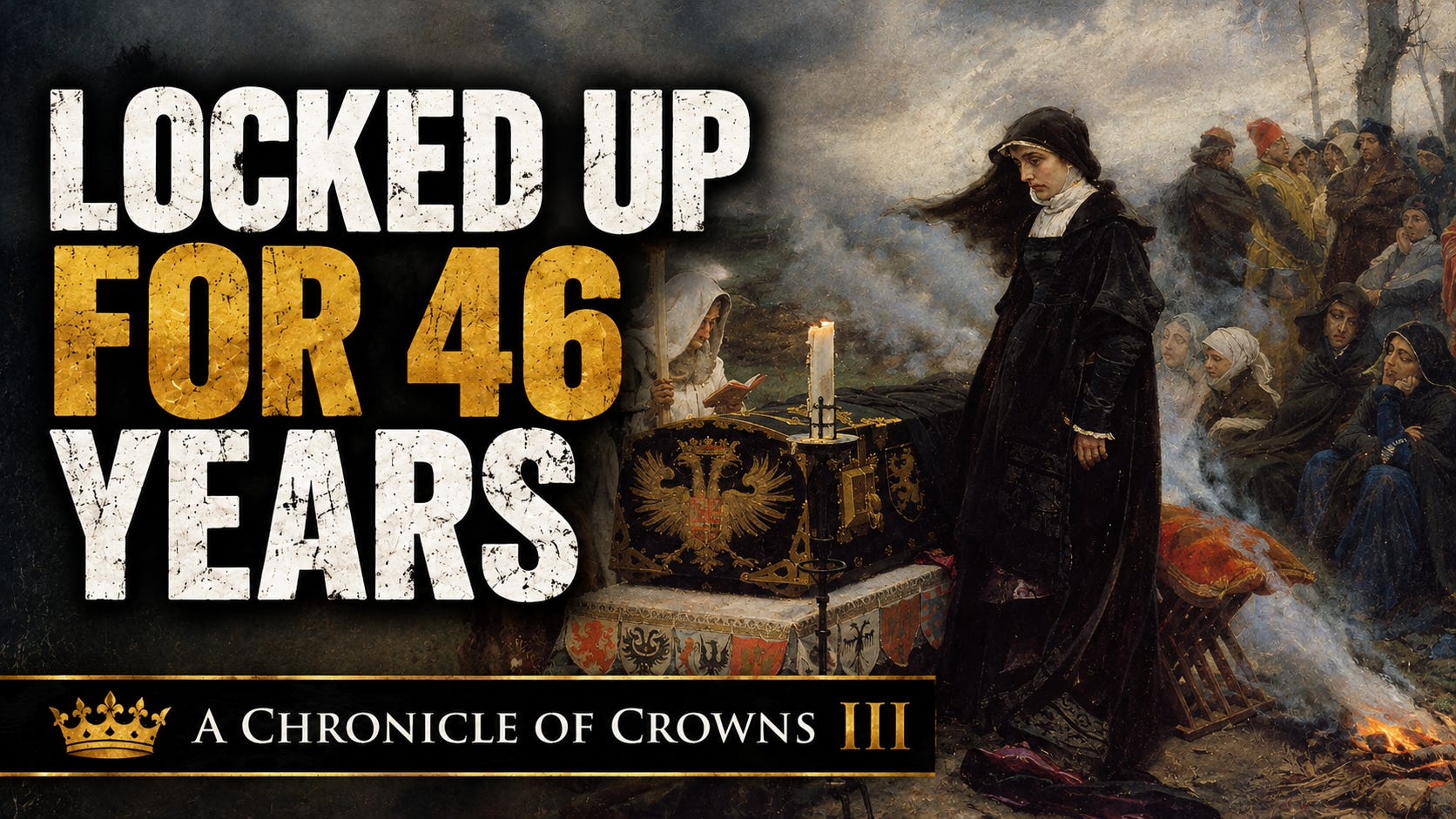
The Queen That Would Never Rule
The Story
FIND ME ON SUBSTACK TIKTOK BUYMEACOFFEE
====>>>>>>> KOBI ONE
This is a public episode. If you'd like to discuss this with other subscribers or get access to bonus episodes, visit kobione.substack.com/subscribe
Every single man in her life had brought her closer to ruin and had plotted to take
SPEAKER_00: from her everything, sanity included. It was all she had left to think about now, endlessly wandering these corridors of the royal palace of Santa Clara in Tordesillas, Spain, Chile. Time had left this once so fine a mind as to be almost void. Nothing but some grief and a lot of cold hatred. Whenever she sat in her chaise longue, here in this prison of room, she was confronted with the ghost of one of these men. Just outside her window, but ten meters removed from her window panes lies her dead husband, Philip the Handsome.
SPEAKER_00: May he rot in anguish. For her, there is no escape, no solace, no refuge. She has lost all but her life, and she will hold on to it for as long as she can. Even if it is just despite the men that still live.
SPEAKER_00: You are listening to the Kobi One Podcast. A new article every Sunday. Read them on Substack or listen to them wherever you get your podcasts.
SPEAKER_00: Buckle in.
SPEAKER_00: With Flanders came Ghent.
SPEAKER_00: And all of its massive wealth due to the grain trade. Bruges and Antwerp gave him their prosperous North Sea ports. And with cities such as Ypres he got his hands on all the wool cloth and its weavers and the insanely beautiful tapestries by them provided. He manages to reclaim all territories lost to the French, such as the almost erased city of Arras. He didn't get this far without having to suffer for it at the hands of the people of Bruges first, during the initial rebellion against Habsburg takeover.
SPEAKER_00: But now that he had ironed out every fold in this finely woven tapestry of Flemish cloth, it was Habsburg business as usual. The wedding machine kicks back into fifth gear and Europe shakes in its boots, while shaking those very same boots to a political game of musical chairs. Maestro, cue the wedding music!
SPEAKER_01: Kobi One kobione
SPEAKER_01: Piano Piano Piano
SPEAKER_00: The Habsburg motto of the era, Bella Gerant Ali, Tu Feliz Austria, Nube. Let others wage war, you, happy Austria, marry. Max would stay true to this established Habsburg tradition. His firstborn is a man some of you will already know as he who accidentally gave way to flamenco. The name we gave to that fiery dance and music of the Andalusian Roma gypsies. This is mentioned in my first installment of Strange Origins. His name is Philip the Handsome, a nickname easily earned when one stems from the Habsburg dynasty.
SPEAKER_00: A family known for many things, beauty not being one of them. In the spirit of full disclosure and honesty, the chroniclers, such as Venetian ambassador Cherini, indeed describe him as to be genuinely beautiful. Readers of my latest Sunday article will know The Worst King to Have Ever Lived which was round about his actual nickname Louis XI who tried to steal the regions of the fallen Burgundian duke now in direct opposition of Maximilian who married this duke's daughter and reclaimed all the territories for himself to undermine the authority of Maximilian and his now firstborn son Louis Lonsiemme Louis XI spread rumors that Philip was in fact a girl medieval gossip surviving the tooth of time juicy oddly enough later on in his life During his actual reign, Philip the Handsome would foster relationships with France, in stark opposition to his very anti-French father, Max.
SPEAKER_00: Max's daughter was named Margaret, later known as the Lady of Mourning. Which bodes well for her love life, does it not? The nickname was given to her by her own court poet, which is a job I am willing to take if you are employing. Putting it out there, she earned the nickname by jumping out of a window after her second husband, Philibert of Savoy, dies.
SPEAKER_00: She was saved and had her husband's heart embalmed to keep it with her forever. She vowed then and there never to marry again and became a very successful and respected woman in politics. All this leads me personally to believe she was much more clever and cunning than most historians give her credit. Her first marriage
SPEAKER_00: explains her father's resentment for the French and her own resentment towards her father and fight for independence at the same time. To calm both sides of the Burgundian borders, the French king on one side and soon to become Holy Roman Emperor Maximilian of Austria on the other, Max married off his daughter Thuy Le Onzième's Dauphin which indeed means both dolphin as does it mean the firstborn son of the French king. Hilarious. She was sent off to the French court to be raised there at the age of three.
SPEAKER_00: So she just tragically lost her mother and and is now sent to a different country to be raised by a family that was hitherto a mortal enemy of hers at the age of three. Dang these middle ages. Worst of all, nine years later, Max makes a political move that Louis le Onzième didn't like all that much, so Louis calls off the wedding and sends Margaret Packing back home after nine years. She is now but 12 years old.
SPEAKER_00: Meanwhile, back in Spain, the country is being united under one crown for the first time in its history. Not counting old Rome or the Visigoths for technical reasons. The King of Aragon, Named unsurprisingly Ferdinand, but I'll use his Spanish name, Fernando, married the queen of Castilla, Isabella, and they each ruled over their own regions, while establishing one empire, as of yet two crowns. These would merge into one in just a generation. When Isabella and Fernando take back Granada and such from the Muslims, from the Moors, Europe rejoices.
SPEAKER_00: This is the first time since the fall of Constantinople that a Christian emperor manages to kick the Islamic infidels off of mainland Europe. Isabella is also the woman that would finance the trip overseas of none other than Columbus himself. All the spoils and riches that would flow to Spain afterwards can be accredited to Isabella. She is yet another phenomenally successful woman from the Middle Ages, with claim to her name both the discovery of the Americas and the first defeat of the Muslims since the fall of Constantinople.
SPEAKER_00: Here, their children in birth order. Isabella, eldest daughter, Juan, the heir prince of Asturias, Juana, third child, second daughter, Maria, and Catherine, who will become Catherine of Aragon, hence her English name, first wife of Henry VIII of England. Isabella and Fernando take a look across the borders and find Maximilian looking back at them, nothing but those pesky French in between. Friends would become stuck in a medieval political wall of death.
SPEAKER_00: The deal was made. They somehow managed, without having read Trump's book, The Art of the Deal. Quite amazing. The arrangement was as follows Philip marries Juana of Castilla Margaret marries Juan of Castilla Two Habsburgs into Spain Two Trastamaras into the Empire France encircled on two sides without a single battle fought While growing into his role as a leader Philip the Handsome danced a beautiful and historically extremely boring rope dance between his Spanish engagement and his pro-France stance.
SPEAKER_00: His Spanish princess, Juana, sailed from Laredo in August of 1496 with a fleet of 120 ships and 15,000 soldiers.
SPEAKER_00: A massive storm completely derails the schedule wrecks big parts of the fleet and totally annihilates one ship killing its 700 passengers. She actually goes through hell the moment she sets forth towards this marriage of hers. Eventually Juana does indeed arrive, presumably at the port of Antwerp, where her soon-to-be husband is not even awaiting her.
SPEAKER_00: She travels with her entourage to Leer, modern-day Belgium, where finally they meet. And the historians would have us believe that soon as their eyes lock,
SPEAKER_00: Electricity Sparks She is sixteen years of age. He is eighteen. They are both chronicled to have been beautiful and intelligent. A priest is demanded on the spot to wed them there and then. The consummation of the wedding was also derailed from its schedule and Accidentally managed to happen before the actual wedding. Must have been a medieval glitch in the matrix. Love was in the air. For Juana, that is. For Philip, it was more a sexy start to a political marriage. The reality, sadly enough, was that Philip would never be able to fully comprehend his beautiful and extremely intelligent wife's past and how it led her into his arms.
SPEAKER_00: She grew up in a dogmatic and extremely strict religious culture. She was the type of intelligent that does not fare well with dogmas. Though receiving the best education medieval Europe had to offer, maybe even because of it, she estranged from the church as far as politically possible, and with it estranged from her family. Something obvious to us today seeing as we have a paper trail of her parents paying a spy to actually stalk her and assess her piety She gets a golden ticket out of this rotten family and the first thing that happens to her is witness 700 people die in bloody agony She arrives in a world vastly different from hers Where she recognizes nothing And then the man she is betrothed to Just stirs something in her soul She is home now Here with him And he shows every sign of feeling The exact same way For now It would not last
SPEAKER_00: Juana was born in Toledo, Spain on the 6th of November, 1479. Strawberry blonde hair, blue eyes, fair skin. She looked a lot like her mother. She inherited from her mother more than just her looks alone. The same strong independent disposition that led her mother to the top might well be what caused the first rift between her and her parents, mostly with her father. Her father had married Isabella for clear political and military purposes, but had not counted on such a strong adversary of a wife.
SPEAKER_00: Her education was exceptional.
SPEAKER_00: Isabella ran a humanist court and surrounded her children with serious intellectuals. Lucio Marineo Siculo, Pietro Martire D'Anguera, and the Geraldini brothers, for instance. Juana studied canon and civil law, genealogy, heraldry, grammar, history, mathematics, philosophy... She spoke five languages, Castilian, Catalan, Galaico-Portuguese, Latin and even French. She played the clavichord, harp and lute. She rode horses and flew falcons. By her teenage years, she was discussing statecraft with her tutors.
SPEAKER_00: By almost every account, she was the brightest of Fernando and Isabella's children. And yet she was also the most difficult, sullen, withdrawn, bookish, preferring solitude in books to court life, her aloofness so total that people mistook it for exaggerated royal dignity. She travelled constantly with her parents between palaces, cities and military camps. She grew up witnessing the annexation of Granada and Columbus arriving in Barcelona with news of a new world.
SPEAKER_00: In a court built on the Inquisition, burning heretics, expelling Jews, defining Spain through Catholic Orthodoxy and all that other good old Catholic stuff, Juana asked uncomfortable questions about God. She was reportedly impious, often expressing religious doubt that made her parents nervous. Her parents apparently dispatched a Dominican prior, Tomas de Matienzo, the aforementioned spy, to Brussels in 1499, specifically to report on her piety or lack thereof. Some historians believe this was actually political cover for concern about Philip's behavior, but the religious skepticism was real enough to generate official concern.
SPEAKER_00: Later, in Tordesillas, her refusal of sacraments would be weaponized as further evidence of madness. In reality, she reportedly expressed nothing but doubts about Catholic dogma and rule rather than outright atheism. The powerful have known for a long time that perception of power is one of the most incredible tools in a monarch's toolbox. Just ask Xi Jinping why Winnie the Pooh was outlawed or censored in China a couple of years ago. If you rule by the grace of God then casting doubt on God is casting doubt on your own right to rule.
SPEAKER_00: Seeing as Juana was an obvious humanist she probably did doubt somewhat her own godly right to rule. The seed was planted. Juana was an unstable impious woman one to be wary of.
SPEAKER_00: Juana was the third child. She was never meant to rule. Her value was wholly assessed through the almighty marriage machine. Two birds with one stone. Get rid of the outlier by sending her to the other side of the world and use her to strengthen bonds and gain territories at the same time. All was planned. All was well. Fate rolls the dice and the other players sat around the table of the universe hold their breaths as they look at the outcome. Juan, her brother, dies in 1497, aged only 19.
SPEAKER_00: Her older sister, Isabella, dies while delivering upon this world her child, Miguel, who would have united Spain and Portugal when he came of age, but he never does. He dies two years later. Three deaths in three years.
SPEAKER_00: The third child, educated for a useful marriage and never expected to inherit anything, is suddenly the sole heir to Castilia, Aragon, Naples, Sicily, Sardinia, and the expanding empire in the Americas. A generation earlier, Mary had to marry Max, tongue twister time, in order to save Burgundy. No succession through the female side was allowed there. The same counted not for Spain. Philip had quite accidentally married the most powerful woman in Europe. He has no interest whatsoever in sharing that power with her And her very own parents Had been helping him build The narrative that would drag her Asunder Namely That she is stark raving mad Crazy Bonkers I tell you
SPEAKER_00: So now all pawns are in place for this Greek epic checkers board of life to unfold and spin Juana's sad fate before our very eyes. Juana is completely cut off and isolated at the Flemish court. Everything is foreign. The language, the food, the awful Flemish weather, the drinking, the Burgundian debauchery. No friends, no family, no allies.
SPEAKER_00: She is surrounded by Philip's people and Philip, well, let's take a look at Philip's behavior, shall we? Although Philip is a serial cheater, jumping from one mistress to the other and flaunting his affairs openly in court and public, he still manages to keep Juana pregnant for the better part of a decade. Six children between 1498 and 1507 Eleanor 1498 Charles 1500 Isabella 1501 Fernando 1503 Mary 1505 Catalina 1507 All six survive
SPEAKER_00: And all six become emperors or queens, an extraordinary dynastic record not often matched. One day, Juana simply has had enough of the total disrespect and confronts one of the mistresses and publicly cuts her hair off. Honestly for the level of disrespect given this was not even overly dramatic but the drama builds. The next mistress she confronts is reportedly struck in the face and yet another might even have been stabbed. Constantly pregnant, constantly being cheated on openly, she goes stretches without eating, without sleeping, she stalks and wanders the corridors at night, sobbing, screaming out in rage and fury.
SPEAKER_00: Eventually, she starts throwing herself at walls and things start seriously escalating. A normal, A decent man might start taking actions towards change or divorce, but this is the Middle Ages and these are the Habsburgs. Philip couldn't have had it better if he would have had it all planned out.
SPEAKER_00: He locks her in her rooms and deprives her of the only thing she is actually craving, his attention and love. He has his treasurer keep a meticulous diary, which would become the nail in her political coffin, a testament to her madness. Trauma Isolation And A Constant Barrage Of Hormone Deregulation Due To All The Pregnancies And The Incredible Side Effects Of Giving Birth Such As Postnatal Depression And Such They All Kept Battering At The Walls Of Her Sanity And Eventually Something Broke
SPEAKER_00: Modern psychologists suggest bipolar disorder and or schizoaffective disorder. She was basically kidnapped and isolated and constantly humiliated until her mind coped with the trauma through disorder.
SPEAKER_00: The Queen Isabella of Castilla dies. And her death leaves a gaping hole in the political ecosystem. The game of musical chairs is now being played to the tunes of some Norwegian black metal band or other. Things are starting to get real gritty. Because of primogeniture, the law of succession, the crown has now officially passed to Juana, with Fernando, her father, acting as a regent. This is where it gets hairy. The empire was not as of yet united under one crown. Fernando ruled over his part and only had influence over the other through his now deceased wife.
SPEAKER_00: This was always the plan. Juana was just not meant to be the one executing it. Before her death
SPEAKER_00: Isabella had explicitly named Juana as the heir to the throne adding a clause that makes a whole world of a difference. The clause stated that Fernando would act as a regent if Juana was absent, unwilling or unable to rule. Isabella had presumably added this clause for when her daughter would be residing in Flanders, half a world away, so that stability could be kept. Fernando read the clause as a thank-you note for years of planning and scheming. Unable could also mean not mentally able, you see.
SPEAKER_00: Meanwhile, Over in that half a world away Flanders our dear Philip is having the very same thoughts. He of course has a desire for the very same crown wouldn't you? And here he happens to be having kept a diary as a testament to exactly how unfit Juana is to rule. He has the right cards in hand for a power grab. He keeps the news of her mother's death from Juana for some time and he plots and he broods. Fernando moves first. He has coins minted with his own name and face alongside Juana's. He positions himself as a regent, citing her instability.
SPEAKER_00: Philip then does the old if he does it I will do it too routine and start minting his own coins. His specific coins were minted in Antwerp and Bruges and named him alongside Juana as the Monarchs of Spain. The power of minting your own coins having your right to rule printed on the legal currency everyone traded in was enormous. Both men made sure the coins were there to back their claims. Here, in Ghent, we still have an entire shopping street named after the Mint, where the residing men and women of power would mint their coins.
SPEAKER_00: It's called the Lange Mint. And this street is, by the way, also the introduction in my soon-to-be-released Ghent Unguided. More information on that another time.
SPEAKER_00: Both men sign documents as though the queen is an inconvenience rather than the actual monarch. By the time Juana is actually told about the death of her mother, she sees rather quickly and easily what is going on. She was not oblivious. She writes a letter to a noble man named Signor Vere, explicitly denying madness. She says she has jealousy issues, claiming she probably inherited them from her mother. She is lucid, precise and furious. It must have been horrible to realize nobody cared about reality.
SPEAKER_00: Her father and her husband proceeded to arrange a meeting concerning the fate of Spain and the Queen. The trip is well documented and will have you at the edge of your seats if ever a Hollywood producer decides to actually make a new movie of some caliber again. Until then, you might want to read my first installment of Strange Origins, where I myself detail the voyage overseas and some of its strange consequences. Through representatives, two treaties were signed. The Treaty of Salamanca was signed first.
SPEAKER_00: In this document, both men were equally recognized as co-regent in Juana's name, Neither man trusted the other or intended to share a crown.
SPEAKER_00: After arrival in Spain, the next treaty is signed. Both parties sign, each from a different city and actually one day apart from each other. Fernando arrived with a small party carried by mules. Philip arrived with an army of men on horseback. Philip wanted to show force, something Fernando had accounted for. That's why he played the role of the sympathetic Spanish father that was being bullied by the foreigner. The treaty they both signed was a formal document declaring Juana mentally incapable of ruling Castilla.
SPEAKER_00: Fernando renounces the governorship entirely. Philip is proclaimed King Jure Uxores through his wife's right, not in his own. Juana keeps the royal title on paper, but she loses what little else she had left. The very same day that Fernando signs the treaty, a day ahead of Philip and in a different city altogether, he secretly writes documents saying he signed the treaty under coercion. He states the treaty does enormous damage to the said most serene queen, my daughter, and me. He files the repudiation One day ahead of time, actually, and says nothing.
SPEAKER_00: He bides his time. The political theater is quite genius. Philip marching into town the next day, armed and on horseback, proves what Fernando was already stating. Now he would slowly but surely gather forces and position his pawns correctly. Like every single plan this man ever came up with, it was brilliant and it totally failed. Fate rolled its dice and laughed out loud when she looked at the other players' faces. Philip is proclaimed King of Castilla by the Cortes of Valladolid on July 12, 1506.
SPEAKER_00: He is, however,
SPEAKER_00: Never formally crowned. He has the title for an entire 75 days.
SPEAKER_00: For the sake of newcomers to the Kobi One podcast, I will read an excerpt here from that first strange origins mentioned above. On September 14, 1506, after lunch with his prime minister, he played a ball game, medieval tennis, with a group of gentlemen. Back then the king always had a group of friends called Les Mignons de Couche, Because they would even share the king's bed at night. Comment later on if you want me to elaborate further. Being overheated from the game of tennis, he drank a glass of cold river water and immediately felt unwell afterwards.
SPEAKER_00: He died 11 days later on September 25, aged 28.
SPEAKER_00: The exact cause of death is still being debated. Often, the death is acclaimed to stem from drinking the cold river water after heat and this then leading to pneumonia. A good story for a joke on why Flemish people mostly drink beer, but it never sat comfortably with me, nor with a lot of historians. A Spanish historian, José María Oh, that's a difficult one. Dedicated an entire book to the case for poisoning. Un proceso por envenenamiento. La muerte de Felipe el Hermoso. 1947. Fernando was conveniently in Naples.
SPEAKER_00: The secret repudiation was already written and waiting. He had already undermined the treaty on the day it was signed. Philip dying within 75 days of being proclaimed king? Of drinking a glass of water with Fernando positioned to benefit immediately? Well, the timing is at a minimum extraordinary. Fernando returns to Castilla in 1507 during plague and famine as the apparent savior. He meets Juana face to face for the first time since Philip's death. A year had passed already. The records of this meeting are vague.
SPEAKER_00: The morning after Philip's death, two surgeons opened his body completely to remove the entrails, then cut open his calves, legs, and the remaining flesh to drain every single droplet of blood and slow decomposition. We had learned by then, much thanks to William the Conqueror of England, that royal corpses should be stripped of their insides as soon as possible. In William's case, the surgeons overlooked it. When the attendants tried to force the swollen body into a stone sarcophagus that turned out to be too small, the bloated abdomen burst under the pressure.
SPEAKER_00: Contemporary chronicler Orderic Vitalis describes the stench as filling the entire church and the mourners fleeing. Philip's body was embalmed, dressed in a royal robe of brocade with ermine, a crucifix on the chest laid on a bier. His heart was placed in a lead casket and transported to Brussels, to be interred in the church of Our Lady, the Notre-Dame of Bruges, beside his mother, Mary of Burgundy. It had become Burgundian tradition for the heart to be buried apart from the body. The powerfully deceased would have their corpses boiled in a great kettle, filled with boiling water and wine, to rid it of the flesh, and then the bones would be transported elsewhere.
SPEAKER_00: Guana insists on having the casket opened to verify he is really there and she ends up kissing the dead man's feet.
SPEAKER_00: With Philip properly prepared, the real journey commences. Juana sets out towards Granada, with Philip's remains in a leaden casket. They travel only by night to keep the body out of the day's heat and to avoid the plague or ravaging the lands. They have a 700-kilometer walk ahead of them. According to the chronicler Peter Martyr, Juana would regularly hold religious services for Philip in the many churches they would take their rest at during the days. Hundreds and hundreds of candles would be lit, possibly to keep at bay the horrible stench of the rotting carcass of her husband.
SPEAKER_00: The procession left the church each time so blackened by smoke, Martyr accounted our skin has been completely blackened by the smoke as if from the Abyssinians. If we are to believe the chroniclers, she actually believed her husband would rise again. She would leave two churches completely burned down in her wake. During the last one, Philip's casket caught fire and was only narrowly saved. She would have the casket opened every so often to check in on him and kiss his feet. Come December, when the casket was opened for yet another checkup, Peter Martyr stated he could by then only vaguely see the shape of a human being, let alone recognize Philip.
SPEAKER_00: With all the wax and smudge, it looked like It looked a bit like a face made out of plaster melting away. Juana would give birth to Catalina, the future queen of Portugal, during this horrible pilgrimage. Her father pauses the monstrous quest for a year and a half before letting it finally resume again. It is speculated he did this to keep Juana out of the hands of other power-hungry men seeking to marry into Spain. All the while, the casket stays with Juana. When she sets off once again, she takes another year and a half to reach Tordesillas, arriving in 1509.
SPEAKER_00: Philip died in September 1506. She has officially guarded the body day and night for three years, letting almost nobody else ever near it. Eventually, the body was moved to the chapel in Granada in 1525. The pilgrimage had come to a close.
SPEAKER_00: Fernando has his daughter confined, once and for all it will turn out, to the royal palace of Santa Clara in Tordesillas in February 1509.
SPEAKER_00: A convent town on the river Duero in Castilla, about 30 kilometers southwest of Valladolid. Her remaining faithful servants are all dismissed. A small retinue loyal to Fernando is installed. And then the doors of Santa Clara close. Fernando is named administrator of the kingdom by the Cortes of Castilla in 1510. Archbishop Cisneros governs in practice. All documents are issued in Juana's name, but signed with Fernando's signature. I, the king. Juana rebels by raging against her jailer, Luis Ferrer, and once more refusing to eat or sleep.
SPEAKER_00: Under Fernando, she had her youngest daughter Catalina with her, and her older daughter Eleanor had created a semblance of a household within the convent rooms. But by the time her son, Charles V, takes over, all got progressively worse. Windowless rooms No more daylight No more visitors Without special permission No news from court Not allowed to sign decrees Or read government papers Correspondents monitored or intercepted entirely Clothing regulated Long stretches where she saw no one But her daughter and some assorted nuns Charles wrote to the convent of Santa Clara caretakers It seems to me that the best and most suitable thing for you to do is to make sure that no person speaks with her majesty for no good would come of it She apparently became convinced some of the nuns wanted to kill her Given what was being done to her this might not have entirely been paranoia really but it was never proved either way She was not told her father Fernando had died in 1516.
SPEAKER_00: She may actually have died believing her father was still alive. Philip's coffin, her husband, was buried just outside her window. She never once asked to visit his grave. She ends up spending the rest of her life, 46 years, locked up as a political prisoner. Her death becomes a footnote in the annals of history. Juana died on Good Friday, April 12, 1555, aged 75 years old. She had been Queen of Castilla for 51 years and had governed for none of them. She outlived her father, Fernando, he died in 1516, her husband, Philip, who died in 1506, and nearly outlived her son, Charles V, who abdicated his entire empire in 1555, broken by age and illness just months after his mother's death.
SPEAKER_00: She was buried in the royal chapel of Granada, beside Philip, Exactly as she had always insisted. No grand procession, no public mourning. The empire was busy.
SPEAKER_00: The first Dutch biography of Juana was written in 1940 by a Dutch man named Johan Brauer. I will attempt to translate a small passage here. What a fact, for a romantic poet... The nightly entry of the mistrustful, grief-driven queen, the funeral carriage flickering torches, monks, prelates, noblemen, soldiers and musicians. An old village, a sloping landscape, frightened farming population, old women whispering of the mysterious powers of death. And then, suddenly, while the dark silhouette of the church, where the dead king lay opened, and the dark flames from the tower set, well, I'm gonna leave it there, I could go on forever, we can even directly quote an English king, Henry VII, for making a case against Juana's supposed madness.
SPEAKER_00: He is known to have said of Juana, not mad, but a prisoner. Let's line up the known culprits. Philip needed her declared incapable to rule Castilla alone through her right. Had his treasure document every episode of the stories and he signed the treaty of Villa Fafilla declaring her unfit. Fernando needed her declared incapable to maintain the regency of Castilla after Philip's death. He spread the coffin procession rumors deliberately across European courts, had her imprisoned in 1509, issued all documents in her name.
SPEAKER_00: Charles Needed her declared incapable to rule Spain and the Holy Roman Empire without challenge. Kept her imprisoned for 46 years. Ordered that no one speak to her. Stripped her possessions. Took her daughter. Earlier in this article,
SPEAKER_00: I mentioned the Signor Veri letter wherein Juana explicitly denies her own insanity and tries to establish her clarity of mind. This on its own does not mean all that much seeing as many mad quote-unquote people do not consider themselves as such. What for me lends actual credence to her claim is her obvious self-awareness. She mentions her own jealousy and notes how she probably inherited it from her mother. During her imprisonment, she features in a document known as the Comuneros Testimony of 1520.
SPEAKER_00: The document is notarized and shows her speaking after already 11 years of solitary confinement with clear intelligence and sound judgment. The document itself is quite an important one and will be further investigated at a later time for different purposes. The Treaty of Villafafila itself also tells us something. Fernando secretly repudiated it on the day of signing. If he genuinely believed his daughter to be so mad, why bother repudiating? The repudiation reveals the declaration was but a political move, not a medical one.
SPEAKER_00: And then our smoking gun. The Bergen Roth finding. The small detail mentioned that she never asked to visit Philip's grave, despite it being only 10 meters from her window for many years. This directly contradicts the entire romantic mad woman narrative. She supposedly spent three years walking around with a corpse because of romantic jealousy and such. She couldn't part with his body. She kept believing he would reappear yada yada yada. Yet here she is, locked away forever with nobody but that husband she kept living so intensely after his death buried so close to her and she never visits the grave.
SPEAKER_00: I don't believe it for a second.
SPEAKER_00: Too many different sources and on too many different occasions is Juana chronicled To have thrown herself against walls, refusing to eat or sleep, confront mistresses physically, wander the corridors at night, constantly sobbing, all the while being pregnant for most of it. This unstable behavior, though extremely understandable, was also quite real. Her family had a documented history of mental illness. Her grandmother, Isabel, of Portugal, suffered severe depression and paranoia, spending her final years in seclusion in Arevalo.
SPEAKER_00: Juana spent part of her childhood there with her. Modern psychologists, working from the historical record, suggest bipolar disorder or schizoaffective disorder characterized by mood episodes and symptoms overlapping with schizophrenia. These are actually manageable conditions, definitely not grounds for 46 years of imprisonment. The key question is not whether she had some form of illness Mentally, yay or nay, the question is whether any illness she had was genuinely incapacitating or whether it was amplified, weaponized, and manufactured into political justification by men with everything to gain.
SPEAKER_00: The definitive academic work comes to us through Bethany Aram's Juana the Mads. Sovereignty and Dynasty in Renaissance Europe. John Hopkins University Press 2005. Aram. She spent years in Spanish state archives.
SPEAKER_00: The conclusion she finally draws, the very same conclusions I have been trying to make a case for here, is that Juana was neither the romantic madwoman of legend nor simply a victim. She was a complicated political actor who used pious press She was misunderstood and mostly very much abused rather than mad.
SPEAKER_00: For centuries this misunderstanding lingered and gave way to oh so many plays and poems. Bergenroth called her behavior heresy. Gachard named her a lunatic. Rodriguez Villa calls her exceptionally devoted wife. And then von Höfler says she was consumed by love. Something stands out. These were once more all men. Possibly themselves still something to gain from Juana's supposed madness, in this case fame and admiration. Only when another woman, Aram, takes a closer look, the world slowly opens its eyes.
SPEAKER_00: Aram broke the mold. The quote that sits at the center of the modern, let's say, rehabilitation, madness, like gender, proved a flexible concept in the realm of sovereignty. I think that sums it up better than I ever could.
SPEAKER_00: Now, I have been slowly dancing around the name this entire article, a name dropped here and there, but never fully explained in more than a couple of sentences. His name is Charles V, the son of Juana that would inherit everything and unleash upon this world a fury that would see the European continent and half of the world soaked in blood for years to come. What has Juana wrought? Both devastatingly nothing and at the same time one of the most brutal errors in modern history. Her legacy is very much the legacy of her son, Charles V. All that Juana does and does not leads to Charles V taking the throne of Spain and establishing the biggest empire the world has ever seen.
SPEAKER_00: Stretching from places like the Philippines, named after his first born, Philip II, to Latin America, North Africa, and half the European continent. Discontent and disarray have been spreading over the European continent. Monarchs, so often far removed from the places they rule over, Physically, mentally and culturally have been taxing their subjects into oblivion and the people start rising up. In Spain, we have the Comuneros Rebellion. In Ghent, the great revolt that would see its proudest citizens parade through the streets with nooses around their necks.
SPEAKER_00: And in 1517, which is coincidentally the very same year, Charles V arrives in Spain from Flanders. Martin Luther nails his 95 Theses to the door of the Castle Church in Wittenberg.
SPEAKER_00: Grinning from ear to ear, wild-eyed, fate picks up the dice. And she rolls.
SPEAKER_00: You have been listening to the Kobi One Podcast. Tune in again next Sunday. I promise I won't take a full hour of your life this time. See you then.
 Apple Podcasts
 Castbox
 Castro
 Goodpods
 Moon FM
 Overcast
 Pocket Casts
 Podbean
 Podcast Addict
 Podcast Republic
 Spotify