Why Did History Forget About Them?
The Story
When reading through history books, it's always men men men. It seems the men writing the books often forgot about the women intheir world. This podcast aims to set teh record straight.In this episode we travel from old Rome and the Britons to the end of the middle ages and the 16th century. In passing we will discover some of the kick-ass women that made this world what it is today! Please consider supporting the channel and keeping it add-free! https://buymeacoffee.com/kobecooman3Get the podcasts early on my Substack plus a whole line of other articles that never make it to the YouTube Channel!https://substack.com/@kobione
This is a public episode. If you'd like to discuss this with other subscribers or get access to bonus episodes, visit kobione.substack.com/subscribe
Welcome to the channel. I'm Kobi One. If you have, like me, ever wondered where were all the women, because it seems like history books are mostly full of men, well, then I've got you covered in this video. So make sure to hit the like and subscribe button and let's get into it.
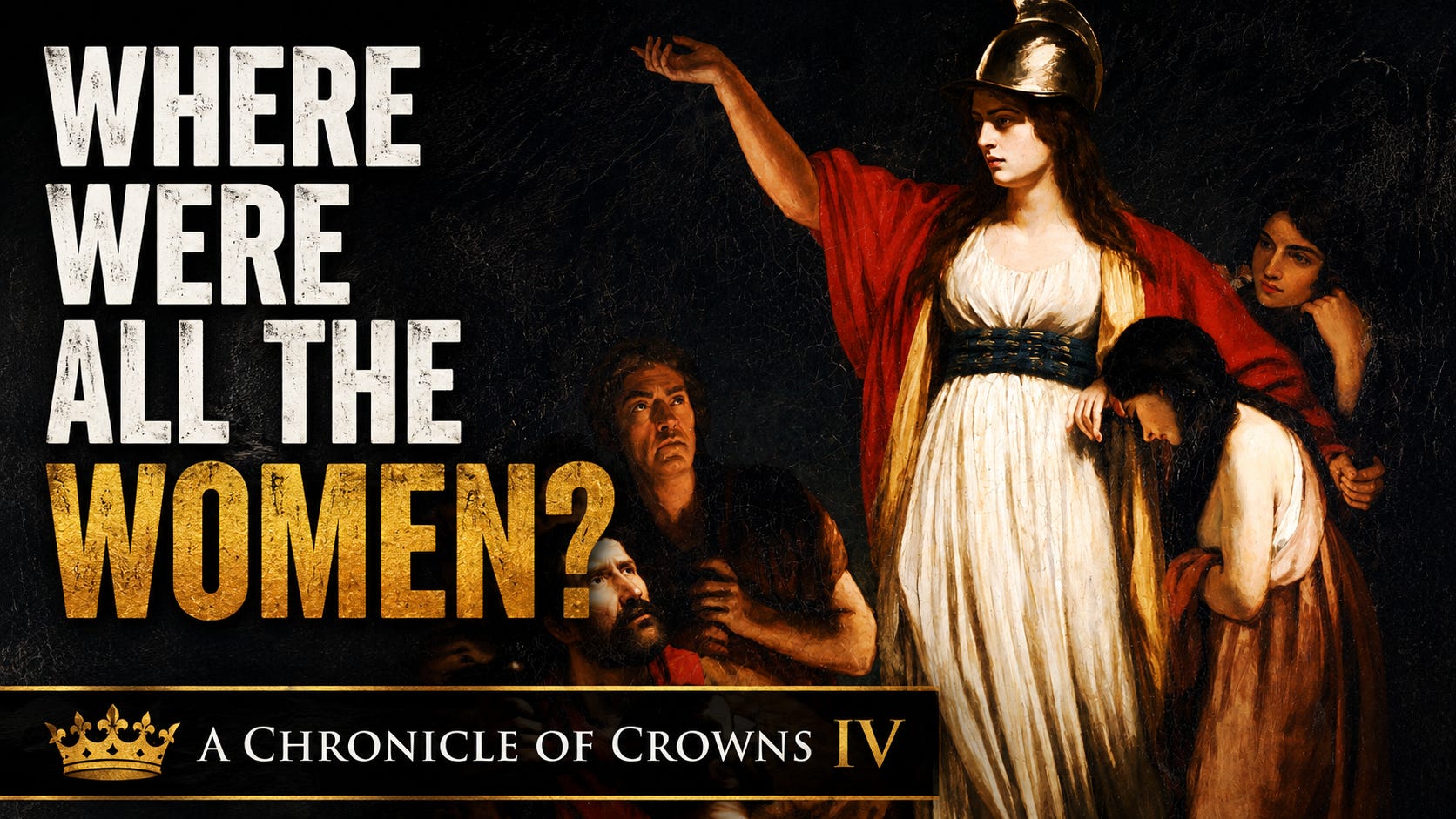
By Jupiter and Mars! Could it be that he heard her voice cut through the sounds of battle, much like their long swords cut through flesh? Hell knows no fury like a woman scorned, but this cannot rightly be the work of a mere mortal woman. Her tall, imposing figure, her great mass a fiery red air. Eyes that stared right through you into another realm. Are we so unused to hearing a woman's battle cry? Whatever it was that commanded this beast of a woman, she seemed to draw strength from the gods themselves.
Now, here he stood. He, Suetonius. Here he is, watching from a safe distance, of course, the cities Nero himself had made him regent over, being sacked and burned and burned again by that blasted woman. First to fall was Camulodulum, Colchester. Pushing the Romans towards Gaul, then Londinium, London, and Virulamium, St. Albans, they fell and they fell hard.
Whoever was left to defend the Roman cities seemed to have a choice. Stay and die or run as far away from Boudica and her assorted Britons as their legs could carry.
After the cities were successfully sacked, the false idols these invaders worshipped so vehemently were given the same treatment as the inhabitants before them. They became the object of utter annihilation. Roman cemeteries were desecrated, statues mutilated, tombstones broken. Suetonius had not accounted for this when he started taking what he considered to rightfully belong to him. Queen Boudicca ruled alongside her husband, King Prasutagus, in equal measure over the Iceni tribe. Already something hard to comprehend for a true Roman governor, a woman having equal rights to power as a man.
He used to scoff at the thought. No more today. What had happened is that King Prasutagus had made a deal with Nero himself and had granted him co-regency over his regents. At the hour of the king's death, the governor, ruling only by Nero's decree, thinks Rome is far away. And wouldn't Nero prefer sole regency anyway? Why wait for instructions? We could be waiting for a long time. Let's take their regents now. And let's take their daughters too. For so it is, so often, when bloodthirsty men come knocking.
Blood is not the only thing they thirst for. Queen Boudica was publicly flogged and watched in horror as her daughters were raped over and over again by the men who served these Roman monsters. Officers and slaves alike went pillaging and plundering, taking whatever and whomever they so desired. These men truly had no idea of the fury that would be unleashed shortly after their transgressions. They would eventually learn about the epic power that is a woman. Or, in Suetonius's case, women. For here they were, Boudicca and her daughters, riding round in their chariots, driving up the men of all tribes, shouting at them that, win the battle or perish, that is what I, a woman, shall do.
You men can all live on in slavery if that is what you want. Suetonius could swear he heard her voice, stern, strong, unyielding. He had fled the falling cities to amass an army ten thousand strong. By all rights he has nothing to fear. Be still, my heart, he quivers. And then the battle is upon them. The Britons storm the lines of defense, and Roman orders are given. All at once, several thousand heavy Roman javelins meet the scarcely armed Britons. How many of them fold like bloody napkins, yet those who stand continue their assault, unblinking.
This is where their bravery, however grand, leads to their downfall. So many were they, they got trapped between themselves and the facing javelins. Not enough room to thrust their mighty lords. Long swords, their attack became a slaughter. This slaughter was sealed by the Roman cavalry, released in time to encircle the falling Britons and mow them down from all sides. The bloodthirst within the Romans having reached its pinnacle, Tacitus records that some 80,000 Britons were killed, while the Romans themselves suffered but 400 casualties.
Even taking Tacitus' words with a grain of salt, as one always should, these numbers speak to an absolute massacre. Boudica was never caught or killed. Her body was never found. She is rumored to have poisoned herself rather than let herself be ravaged once more. What she left behind is so epic in nature, the name could not be more apropos. The Boudican Destruction Horizon. Wherever you start to dig in the cities she once laid waste to, you eventually get to a layer in the sediment that is just a thick band of red, burnt ash.
The fires she sprung on these cities burned with such intense heat that they melted glass, scorched building materials, and baked the earth. Today... Archaeologists use this distinct blackened layer of scorch and ash to mark a specific point in time. A woman's revenge so thorough, its precise moment in time is baked into the soil on which many empires have been built thereafter. This podcast is dedicated to all the women, named and unnamed, who have shaped history and formed our reality. Welcome to A Chronicle of Crowns.
Where were all the women?
You are listening to the Kobi One Podcast. Welcome, and let's dive right in. History belongs not to men alone. Though it is even called his story, her story seems at least of as much importance, does it not?
Something occurred to me whilst writing a Chronicle of Crowns. Women are often glossed over. Often named only for having given birth to the men of whom I so often speak that it almost seems conspiratorial in nature. I myself am guilty of my own charge. My one podcast dedicated to a woman is a truly sad affair. It's about Juana La Locca. Mentioned in that very podcast, however, there are two women who stand out mighty and tall throughout our timeline and who shape it to an insane extent. So merely glossing over these women seems dishonorable.
Let's set that record straight.
Isabella was not born wearing a crown. Succession through female side was a thing in Spain, but when her half-brother Enrique IV dies on December 11, 1474, the kingdom splits in twain. His daughter,
Named Juana, just like Isabella would name her own unlucky daughter later on, claims the throne alongside Isabella. Already a decade now, rumors have spread of her potential not-so-royal origins, but Isabella had put herself in a not-so-much-better position. In fact, she would have had total, uncontestable claim to the throne if she hadn't married Fernando in secret, against the signed and agreed-upon contract with her half-brother. It boiled down to this. Her half-brother named her heir as long as she would only marry someone of his choosing.
Chances are Isabella saw this as abdicating the throne to one of her half-brother's friends and having to spend her entire life married to the bastard on top. She chose her own husband and they married in secret. Juana was put back on top of the list. Isabella scratched off it. Then Enrique IV dies, and turmoil once more hits the continent, or at least that's how the chronicles write it. I doubt the men and women, working day in, day out, surviving off of turnips and onions, ever had strong feelings about the political games of musical chairs that kept happening in the powers that be.
But then again, I might be very wrong. It is said we will never get to hear their accounts. Either way, both women were proclaimed queen by their own factions, and war ensued. Nothing but rivers of blood coursing through his, her story's timescape, it seems. The king of Portugal, Afonso V, came to Juana's aid, a marriage between This is what moved an internal succession dispute into an all-out international war, so...
The peasants did probably pay some mind to the political happenings of the day through their version of Twitter, which was mostly men with loud voices, which again sounds just like Twitter. Even France got involved, and seeing as the head of the French... Were the French royals? Well, they chose in favor of the incest team. Thus began a war called the War of Castilian Succession. Yeah, I know, not the most creative war title ever, but at least it does say exactly what it was all about. Well, leaving out the incest, of course, but I'm sure that was not intentional.
The war ended with the Treaty of Al-Sah-Sovas, oh God, should have practiced that one, Portugal.
And a claim on Fez, plus a large cash indemnity.
Juana was required to remain in Portugal rather than return to Castilia. Her marriage to Afonso, never consummated, was annulled by Pope Sixtus IV under pressure of Isabella. Juana took the religious name of Sister Juana, At a Franciscan convent in 1480 and continued to sign her correspondence La Reina,
the Queen, until her death in Lisboa, 1530, having never formally renounced her claim until well into 1522.
Isabella's marriage to Ferdinand, Fernando, was negotiated. It wasn't romantic. And the terms were pretty unusual for the period. The agreement kept Castilla and Aragon as legally distinct crowns under joint rule, rather than merging Fernando's authority over Isabella's kingdom. Isabella retained full sovereign authority within Castilla. All decrees, appointments, and governance there required her assent, not Fernando's alone. The two crowns were only unified administratively over subsequent generations.
Formally, they stayed separate, let's say, kingdoms, regions, sharing one monarchy. This is why I believe Isabella to be strong, willful, smart. She had a chance at an easy crown. Marry whom you are told and take the terms dictated to you. Or... Choose your own man and set your own terms and then fight till you die defending them. This warrior spirit becomes apparent when in August 1476 a rebellion broke out in Segovia but Fernando was elsewhere, staving off the Portuguese forces. Isabella rode out herself and stamped out that rebellion like a bad roll-up.
She was a woman who knew how to get stuff done and did not mind doing it herself.
Then there was the war against the Moors. It cannot be overstated how epic in proportions was the collaborate effort of Isabella and Fernando to win the 10-year war in Granada against the Moors. The European powers that shouldn't be were really needing a victory. And since the fall of Constantinople they weren't getting any. Until now. Having named this victory sets her apart from other rulers of that time already, but let's not forget she is a woman. She went further than mere rivers of blood. Contemporary chronicles.
Fernando del Pulgar records that during the siege of Allura 1484,
Isabella sent six large tents to the field along with physicians, surgeons, medicine, attendants, and ordered that treatment be free, with the crown covering the cost. These tent hospitals were referred to at the time as the Queen's Hospital. At the fall of Malaga in 1487, the Queen's Hospital followed the army into the city in a train of 400 supply wagons.
Is generally cited as the first documented field hospital system attached to an active military campaign in European history, predating later better-known field medicine reforms by centuries. Isabella is also credited, alongside logistical reforms in supply, with converting Castilla's forces from loosely coordinated noble militias into something closer to a standing, centrally organized army, permanent units, crown-appointed officers, and the capacity to sustain multi-season campaigns rather than short seasonal raids.
Isabella was present at multiple sieges in person, including extended stretches at the camp during the six-month Siege of Baza. 1489, where her presence is credited by chroniclers with sustaining morale among both nobles and common soldiers during a siege that badly strained Castilian finances. And here, as a character, Isabella falls apart for me. Isabella has a direct hand in one of the most brutal and coordinated expulsions of the old world.
Isabella and Ferdinand petitioned Pope Sixtus IV for authority to establish an independent inquisition under crown rather than papal control. Citing reports from 1475 onward of conversos, which is Jews who converted to Christianity, many under earlier waves of persecution, going back to 1391, who were in fact secretly continuing to practice Judaism. How dare they, I know. Sixtus IV granted the bull exigit sincerai devotionis affectus on November 1st,
1478, authorizing the monarchs to appoint their own inquisitors. Then... After the fall of Granada, the Alhambra decree was issued. In fact, in the exact same year as where Isabella funded Columbus's voyage. Oh, for newcomers to the Kobi One podcast, that is another feather in this lady's cap. She is directly responsible for the, let's say, rediscovery of the Americas. The original discovery, I'll give that an article later time. The decree ordered all Jews in Castilia and Aragon, who had not converted to Christianity, to leave by July the 31st, 1492, under threat of death, and barred them from taking gold, silver, or horses out of the kingdom.
Contemporary chroniclers' estimates range as high as 300,000 to 800,000. Modern historians generally put the figure closer to 40,000 to 100,000, expelled, which should already sound like a lot even for today, but back then, by golly. A further 40,000, 50,000 ended up converting to remain. The decree stood formally until it was rescinded by the Spanish government on December 16th, 1968.
Then comes the second lady of the story, Margareta of Austria.
When the last Burgundian Duke of Flanders fell, stabbed to death, frozen in a ditch, face eaten off by wolves, the last Burgundian Duchess, his daughter Mary, faces some serious trouble. She needs an army to fend off the French. She marries Maximilian of Austria because of his great, big, standing...
And he was in it for the money. They had two children together. Philip the Handsome and Margaretha of Austria. Mary herself dies in a strange riding accident. She falls from her horse and breaks her neck. She leaves behind but whispers of a family that once stood tall amongst kings and queens. Nothing but whispers... And her poor children, of course. Margarethe is but two years old.
Almost immediately after, she was taken from Ghent under armed guard as a toddler, specifically so Maximilian wouldn't change his mind about the treaty he had made with the French king himself. A treaty marrying her off to the king's firstborn to establish some peace in the regions and amongst the families. She travelled with a governess by the name of Madame de Bousanton. And was formally handed over at Hazdin to agents of this very king, Louis XI, who would become famous as le roi le plus terrible qui fut jamais, in the presence of a lady called Anne de Beaujeu and her husband.
She entered Paris on June 2nd, 1483, to public acclaim, dressed in black satin with gold threads, and she was betrothed the next day at Amboise, after which she was addressed as Madame la Dauphine, Lady Female Dolphin. When Louis XI died two months later, she was, now by name alone, Queen of France, though still a toddler. Anne de Beaujeu, Who effectively ran France as a regent for her younger brother, personally inspected the child for physical deformities. Standard practice for a future queen.
And she found none. She then took charge of her education. French language, reading, writing, embroidery, painting, music, and a custom-made bow for archery. The finest education money and power could procure. So she could be molded into a perfect queen. So many hours. So much effort. And all of it for absolutely nothing. The younger brother came of age. Charles VIII. And he wanted Brittany. Could not get enough of...
He could marry Anne of Brittany and steal her from under the nose of his nemesis, Maximilian, whom was already engaged to Anne himself, while at the same time dropping Max's daughter, Margaretha, like a stone. The sheer drama alone is this Jersey Shore or what? She wasn't immediately released, not even after the annulment. France kept her as a hostage for two more years, specifically to leverage the return of her dowry lands, Artois and Franche Comté. During this limbo, she reportedly wrote to her father, I want to go home, even if it is only in my chemise.
She would get her wish eventually in May of 1493 when she was finally released together with her dowry.
She has now been engaged once. She will still marry twice. Marriage numero uno. She married Juan of Asturias, heir to Fernando and Isabella, in April 1497.
He was 18 years old, and reportedly fell for her almost instantly, and by every account this was the one marriage in her life built on real mutual affection rather than pure statecrafts. It lasted six months before he died. Likely tuberculosis or a similar wasting illness accounts vary. She was pregnant at the time of his death. The pregnancy ended in stillbirth, meaning she lost both husband and child within a short span. She stayed at the Spanish court for roughly two more years before leaving in September 1499.
For readers of the last episode, Juan stood first to inherit the Spanish crowns and his death eventually leads to the brutal story of Juana La Locca. Then the second marriage. She married Filibert II of Savoy in 1501. He died in 1504 of pleurisy after a hunting-related chill. They had fostered no children. After this, Margareta simply refused all further marriage offers, including a serious push to marry the widowed Henry VII of England. She committed to a permanent black mourning dress that would have made Johnny Cash proud.
Philip the Beautiful, Margareta's brother, died in September 1506 in Spain.
Reasons unknown, though heavily speculated, at the age of 28. He left behind a widow, Juana La Loca, the star of my previous Chronicle of Crowns, and many young children, including Charles V. Margarethe herself was formally installed as a regent or governor of the Netherlands as a direct consequence of this man's death, not even a year after. As Charles V comes of age, the whispering in ears by malevolent, power-hungry advisors starts. You can imagine whichever favorite evil advisor from whichever favorite book or film.
They will probably fit the description rather well. The man in question here was named Guillaume de Croix, the Lord of Chievre. He wanted to oust Margareta ASAP so he could bend and mend pro-French sentiment within the Flemish courts. For a moment, it worked. Charles V was young, easily manipulated. Guillaume had managed to toss Margarethe out of Flanders and put Charles V in direct opposition to his own grandfather. This doesn't fare well. It never does when foreigners try to worm and wiggle their way into Flanders.
This time, no rivers of blood, though. The gap between Flanders and the people supposedly governing it, it became too big. And when Fernando of Aragon, the father of Juana la Loca, croaks and drops all of the crowns he was juggling on Charles V, well, his empire, it just grew very, very big. And indeed, very unruly. He needed people who he could trust. Who were rooted in, well, in the regions they would eventually rule. Or he would lose control over all of it. He asked Margareta back onto his council in 1517.
Who restored her ability to sign state papers and control finances. And he gave her a substantial annuity. This functioned effectively as an admission that dropping her had been a mistake. In 1518 it was made official. Margareta was back. In black. Her full regency powers were restored and they would stay so until the day of her very death.
Charles V lands in Spain in 1517.
That's when he requires Margareta's aid so dearly, for this is when the man that has showed up in so many episodes of A Chronicle of Crowns already, Maximilian namely, dies. He dies leaving the title of Holy Roman Emperor to blow in the political wind, and whoever catches it first gets to keep it. This title, this crown, was not hereditary, you see. So the game was on. Margaretha had been trained her whole life for this very moment, having spread her web all over, having learned from the best there was around, she sets to oil the political and financial machinery until it hums and purrs and resonates to the Habsburgian tunes.
She is recounted to be one of the biggest sources of help in securing Charles' election against France's, who is that? François, probably. François Le Premier, François I, France and Henry VIII.
Imperial elections at this level were essentially bought via bribing, so it's a lot like today. They had to bribe the electors, and she, Margaretha, was directly involved in that very campaign. Charles won on 28th of June, 1519.
It pays off big time. Margareta became the only person, let alone woman, ever that was granted regency without a time limit by Charles V. Every single other region throughout the world, from Europe to Latin America, to Asia, the Philippines were named by Charles V, after his third-born son, Phillips II, to North of Africa.
All of the governors in all of these places ever had been given fixed or conditional terms. Not Margareta. She was in for life. Her journey is one of being stolen away as a baby to being married off twice. The first marriage was reported to be full of happiness. It ends in death. The second one merely political. It ends in death as well. She then went on to potentially stage being so grief-struck by the death of her second husband that she would manage to convince her father, the man of the marriage machine, to allow her widowship for life.
And then she used this status and all of the contacts and the wisdom the years and her entourage had endowed her with to grow in the political ranks. She still gets ousted, but she had made herself so unmissable, she is reinstated. She then goes on to win and safeguard one of the biggest titles out there in the annals of history, for the boy she herself had helped raise. And... She's then rewarded with power for life. Boo-yah! If that isn't an epic woman and her story, well, I don't know what else to tell you.
But the question I ask in the title of this installment is not, where were all the wealthy women? So, where was everybody else? The answer, like so very often, is that the women were out there doing the heavy lifting, pulling the weights and getting little to no mention in the history books for it. Keeping the world running seems to be an unthankful job, at most times.
So, where were all the not-so-wealthy women? Women's rights in the Middle Ages, specifically in the Low Countries, weren't as non-existent as one might suspect at first. They were still quite confusing and wildly degrading when looked at through our modern lens, but still they were a great deal more existent than in most other parts of medieval Europe. Here in the Low Countries there was a law for women stating they were entitled to certain privileges, such as being compensated financially for work done and having self-beschickingsrecht, right to self-determination.
Two big caveats. These rights and privileges would disappear as snow before the sun soon as a woman married. Then the man would retain all rights in the woman's name. They were also, generally speaking, not allowed to form a guild or to be part of guild life. Here, some of the jobs done by women back then. The yarn and wool preparation workers. Civic ordinances from Ghent and Bruges barely bothered to regulate spinning and wool prep compared to weaving and fulling because officials didn't consider these low-level, non-Ghent.
And left almost no paper trail because no one thought it was worth recording.
Yarn market sellers. Ghent, Bruges, Aardenburg, Erre, Saint-Omer, all had dedicated yarn markets, with a 1282 Bruges ordinance directing yarn buyers and sellers to a specific area by St. Salvatore's churchyard. This is where a lot of women's independent, small-scale trading actually happened, outside of guild structures. Brewsters and Alewives.
Fish Wives.
Visual record survives via a 1570 sketch by a Flemish expatriate, Lucas de Heere, showing a London fishwife's dress closely resembling garments in Flemish paintings of the period. Widowed tradeswomen taking over husbands' businesses. A very common pattern, especially in victualling trades, like innkeepers, taverners, cooks, fishwives, brewsters and such, and textile trades. Margareta's life demonstrates widowhood was often the only legal loophole into visible economic power for women.
And here it gets particularly stupid. A female dyer, for instance, wasn't permitted to lift cloth from the vats. And a female pastry maker could... Silk Weaving.
One genuine exception. Medieval silk-weaving guilds had women controlling the entire process, with female supervisors and guildmasters as the actual norm rather than the exception. Debt Collection Proxies A small but sharp detail. Men were sometimes formally authorized to collect debts on behalf of business women because women weren't permitted to demand payment themselves in person. A good illustration that, though, women were allowed compensation for work, they were still made to jump hoops soon as the work involved higher echelons of society.
I will finish this list with an example that mostly survived in folklore. The problem with Flemish history, you see, is that a lot of it got destroyed during the Protestant rebellion of the 16th century. The French Revolution and then still the Industrial Revolution. Sometimes folklore isn't all that we have left, but this specific folklore is so widely spread and occasionally referenced that there is a good amount of certainty about it. After you had just, for instance, sailed the Northern Sea from Great Britain into Bruges, you would most likely take your charge and load it into some smaller canal boats.
These would in turn... Have to be pulled from Bruges and its seaport over a series of wooden roads, towpaths, lining the canals. Most of the time the people pulling these boats would be women, often in their later teens or early twenties, i.e. before getting wed. Can you imagine the sheer amount of work that goes into tugging boats with ropes over, for instance, the canal connecting Bruges to Ghent, which was 45 kilometers, or 32 miles long?
Tough ladies, to be sure. But, once more, being wed put an end to these outrageous shenanigans of a woman earning herself a living by doing the jobs nobody else could be bothered to do. This led a certain woman to go on one of the oldest recorded feminist campaigns ever. Her name is Anna Baines. She was definitely kick-ass. Anna Bynes was a famous poetess and teacher from the 16th century, Antwerp. In part famous for a poem advising women, This
could be translated rather loosely to Unbound is best, a prosperous woman without a man. As soon as you married, as a woman, you lost any and all rights or privileges you had, however few they already were. The worst part, this law stayed in effect in Belgium until 1958. If you wanted to open a bank account in Belgium, as a married woman in the year 1957, you needed your husband's express permission first. So, Belgium in the Middle Ages... Quite progressive. Later on, maybe not as much. This is why some women banded together in, for instance, the Grote Begeenhof in Mechelen, a Beguin, or Begeen, order that housed 1,500 women or more at any given time, for a good four centuries.
These were all women that sought freedom and right of self-determination. They could live a religious life without permanent vows. They took life, at the margins, a couple of steps further. Further away from the world of men and closer towards independence. They ran their own micro-society, built their own communities, where they literally ran their own somewhat separate economies and answered mostly only to themselves and gods. Honestly, it sounds absolutely awesome. It is, or at least it was close to, the single most enormous example of organized female independence in the whole of the medieval low countries.
And it happens to be in Mechelen. The same Flemish city that probably hired the very first municipal musician, a caronneur in the world, and the exact same city where Margarethe of Austria would be found raising Charles V. Mechelen sounds like it was quite the place to be way back when. And for your information, it is still a beautiful place to visit today. If there are any travelers amongst you seeking beauty, you now know where to go. By the way, it was also the seat of power for our dear Margareta of Austria throughout her entire political career.
This seat... Would not be just your average household seat. Margareta herself might have been simply back in black when it came to her mourning clothes that she always dressed in. But she had some swag, ladies and gentlemen. She had some serious swag. Let's visit her place in Mechelen to see just how far a woman could make it in a world constructed to keep her small.
Just like inside of the monasteries that the Habsburgs helped build and made their early fortune through, Margaretha's household was run like a well-oiled machine you could quite literally set your clock to. Here is what that looks like as a timetable. Information collected from Francis Wayne's book, De Zenderen de Zestiende Eo. 5 a.m. The day begins. The very first ordinance of the day dictated the rhythm. Once she'd arisen, her bedchamber would be opened and no one else would be admitted. Chamberlains and stewards guarded the door so nothing could interrupt the routine.
Then breakfast, taken privately during her own extended toilet dressing routine. Not a communal mean, more like a private ritual before she was formally on. Then the mass, followed by breakfast before the day's public business began. Then lunch, midday meal, the big one. In Mechelen they knew how to lunch, let me tell you. In summer they would start at 10 a.m., in winter at 11 a.m. The lunch would then last for two to three hours, every single day again. This meal was in fact public, and quite grand, and indeed very performative.
At lunch, hierarchy and sex-based segregation were mixed in with medieval tradition, to form... A true dance choreography merely to get seated. People had to show up an hour ahead of time to be able to be assigned their seats according to rank and gender. Margareta would be seated at the head on a little platform so she could see the entire room's seating arrangement play out in front of her. Reinforcing that the hierarchy was for her benefit to observe and The book
details an oddly specific piece of ceremony. The breadmaster had to carry the salt cellar between his fingers in a prescribed way. The winemaster and the glass servant stood only to the Supper.
Supper would be served at 7 p.m. sharp. It was a much smaller and often lighter meal than lunch. In Margareta's household, the day would always end in music. The perfect cue for escorting the children off to their own bits of medieval theater and entertainment before bed. The household itself was massive too.
Up to 150 people were in the house on a day-to-day basis. The library counted 340 manuscripts and 46 printed books, including chronicles, romance literature, and a goddamn mapai mundi. I am not jealous. This was one of the first serious princely libraries in the Netherlands, and it functioned as a real research reference collection, not decoration. Margareta even had a Wunderzimmer, Wunderkammer, before it was cool. Her collection is directly credited by art historians as the founding instance of the Habsburg Kunstkamer tradition, the format later famous at Vienna and Ambras.
Spread across multiple rooms on the first floor of her residence. It held books, tapestries, paintings, sculpture, scientific instruments, medals, naturalia, and objects in ivory, silver, gold. All of it deliberately encyclopedic. She was leaving a legacy. She owned an Aztec feather shield and a stuffed Quetzal bird from Central America. The Spanish had literally only just gotten to Latin America 25 years earlier. Talking about ahead of the curve.
A 2005 Mechelen exhibition cataloguing her and Margaret of York's combined holdings, it's called Damas met Klasse, ran to over 150 surviving objects across every category. Playing cards, prayer nets, pomanders, chasubles, sculptures, tapestries, game boards, you name it, they got it.
We could be here for some time more, but I consider the point now firmly made. She made it. And she made it big. And she made it herself.
So, it seems that women were all over the place in the Middle Ages. Who would have guessed right? And much like it still is today, their stories remain mostly unsung. Because they were out there keeping that world turning, doing the dirty jobs, the heavy jobs no one else could be bothered to do, and earning themselves very few lines in his story for doing so. My mother is one of those kick-ass ladies of today and very much an inspiration for this piece. My father and her had eight children together.
Because my father faced his own physical and inhabilitating battles, a lot of weight came crashing onto her. She carried it with pride and dignity, often working two jobs and doing most of the household, cleaning, cooking, everything. Six of my seven siblings are girls. Can you imagine the household of six girls plus two boys? No, you can't, trust me. And I will never for the life of me understand how she did it. But at least hereby, an official record of her unbelievable achievement exists. So...
Can you imagine all the unsung women out there that kicked ass and helped put those men of power on their thrones after they had cleaned their diapers and fed them their porridge, just to then go off tugging boats, brewing beer, and throwing themselves out of windows at the chance of some political freedom? I hope after this article, now you can.
You have been listening to the Kobi One podcast, a chronicle of crowns where we're all the women. Tune in next Sunday and let's see what we'll be talking about then. Thanks for listening. [music]
 Apple Podcasts
 Castbox
 Castro
 Goodpods
 Moon FM
 Overcast
 Pocket Casts
 Podbean
 Podcast Addict
 Podcast Republic
 Spotify