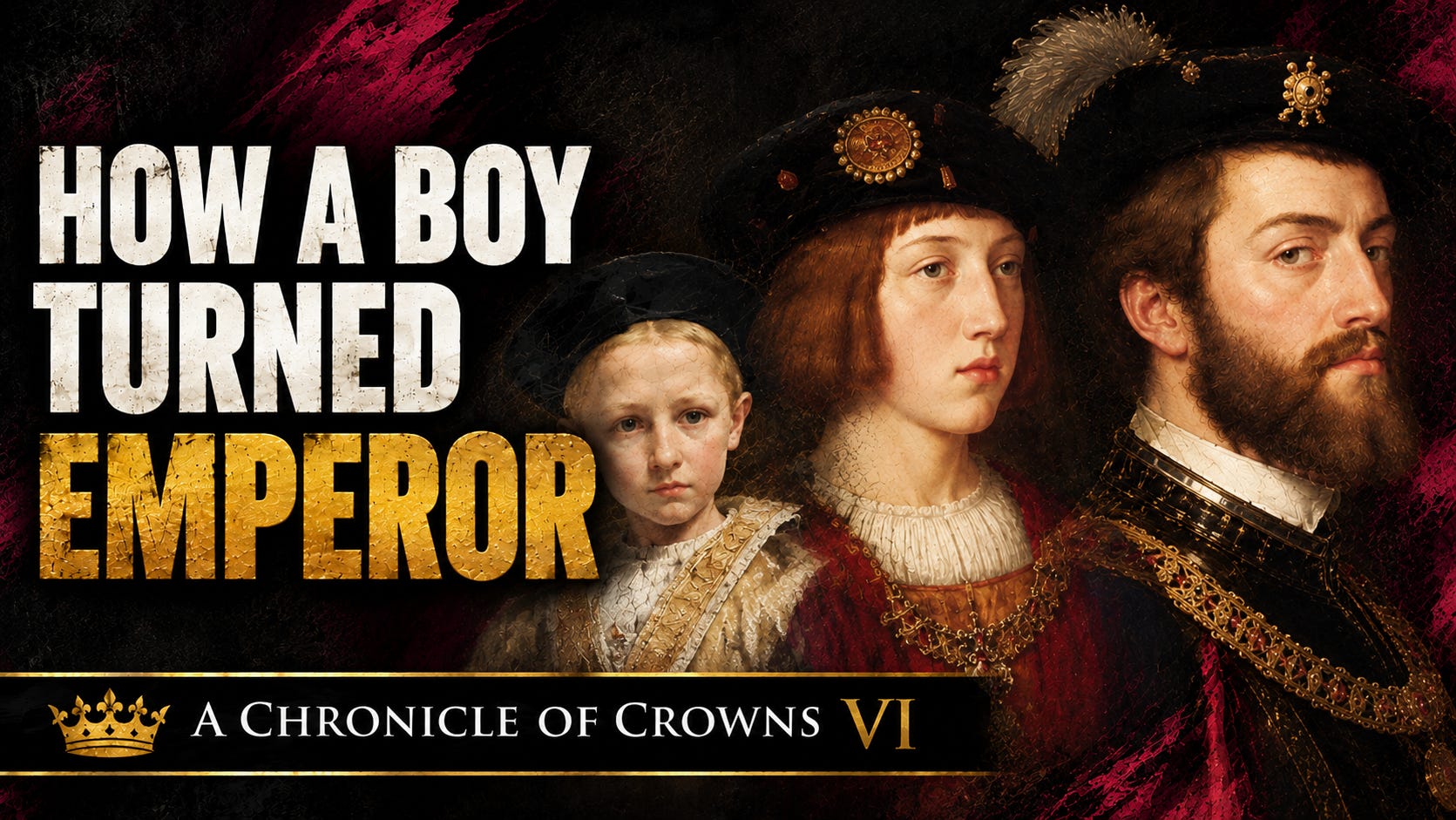
Three Men, Two Advisors And ONE CROWN
The Story
Welcome to the channel! I am Kobi One and in this episode we discover how one game of tennis led to the creation of an empire and mostly, it's emperor!
SUBSCRIBE for a new podcast every week!
CLICK LINK TO BUY ME A COFFEE!!
This is a public episode. If you'd like to discuss this with other subscribers or get access to bonus episodes, visit kobione.substack.com/subscribe
This crown better be worth all of this hassle. At least everything was going exactly according to plan. I almost couldn't have dreamt it any better. My wife, oh my beautiful loving wife, Juana, she made it all so very easy.
It would have never worked. In fact, none of this could ever have happened if she wouldn't have fallen so madly in love with me. Can't blame her for that. I understand. Well, there was, of course, all those people that had the good manners of dying so the crown could actually reach my wife. But credit where credit is due. Juana, thank you ever so much. Admittedly, it wasn't as easy keeping her away from Spanish sympathizers as it was at the Flemish courts. Here, people actually cared about her. Keeping her half-sister, Juana of Aragon, out of my hair was proving very difficult, if not impossible indeed.
Well... It is her husband's palace, after all. I'm sure she is spying for my dear wife's father, Fernando. Well, I showed him. The crown is finally secured. He signed the documents and everything. I have been working so much. I haven't even had time to hunt properly. Time to finally rest a bit. Let's let loose. I shall accept Juan Manuel's invitation and join the banquet at the hilltop castle of Burgos. It might do me some good.
It didn't. Eight days later, he was dead. Philip the Handsome thought he had secured for himself the crown to a newly centralized Spain by giving credence to his own wife's madness. But fate rolled her dice. Philip lost the round and paid with his life. We all know fate cheats when she rolls.
This is the story of how one almost king's death, quite by accident, leads to the creation of an empire and its emperor, Charles V. Welcome to the channel. I am your host, Kobi One. Let's dive in.
When Isabella of Castilla, the ruler of half of modern day Spain, the lady that started the Inquisition basically and paid for the discovery of America when she died, her crown ended up with her daughter. Her name was Juana, Juana la Locca. I have gone over her life in a previous episode where I tried to prove she was not mad at all. She was, for lack of a better term, a political prisoner and a victim of abuse and happenstance. She was never meant to rule. Her father, Fernando of Aragon, was the first to start plotting against her.
Feeding into rumors of mental instability, Having a Dominican monk spy on her to assess her piety and being an all-around douche, her husband then took upon the act. Two can play that game, says he. He had her secluded from any possible allies. He cheated on her constantly, even though he had her continuously pregnant for the better part of a decade. He then had a man keep a clear record of all of her episodes as a testament to her madness, make her mad, drive her mad, and then claim the madness as a reason to take over.
Both men play at this game, and they play hard. Just when Philip thinks he has won, fate rolled her dice. The banquet Philip attends becomes his last. After the banquet they went riding. He hadn't been able to indulge in fun for a while, what with all the scheming and plotting and cheating. So indulge he did.
Invigorated by the ride, he felt so dapper, he challenged a man that remains somewhat shrouded in temporal mystery to a game of medieval tennis. The man is apparently good. The game stretches and goes on for much too long. Overheated, Philip cools down without covering himself up in furs nor blankets. The next day, he wakes with a fever, feeling unwell. He apparently thinks to himself, fuck it, I'm going hunting, because that is exactly what he does. In retrospect, I think it was a good idea. It was the last chance he will ever have to go hunting.
He does not yet inform his physicians of his ails. Mayhaps, because, you know, they wouldn't let him go out. The fever gets progressively worse. And the next day already, there is no hiding the fact that he is suffering and not faring well.
The date by now is the 18th of September, 1506. It has been between four to five months since Philip arrived in La Coruña, Spain. It had only been eleven days since he arrived here in Burgos. In the palace he would never again leave. By the twentieth, the decline turns unmistakable. Chest pain, coughing blood, bleeding, cupping, purging. And by the twenty-third, the blood drawn from him runs thick and corrupted. Sangria resia imala. The chroniclers of the day call it. The fever hits harder and red and black spots spread across his skin.
On the 24th he's dying and everyone around him knows it. A regency already forming at the bedside. One faction backing Maximilian as protector for young Charles. Another wanting Fernando recalled to govern while Cisneros sends word to Fernando in Italy that the uncrowned king is critical. Philip dies on the 25th at the age of 28. Juana beside him to the end. The physician present would later be found saying he'd never seen a woman of any rank behave with such composure. That, while the room filled with men already weighing what his death meant for them.
The only person seemingly caring more about the man that hadn't even died yet than his crown was Juana, the only one to whom the crown really belonged.
As everyone around her started fighting over the crown, she occupied herself with her cheating, plotting and now dying husband. She deserved so much better.
Rumors of poison follow fast. Fed by the timing. A foreign usurper struck down just as Fernando stands ready to reclaim his place, though his own physicians reported no signs of it. His cupbearer, whose job included tasting the king's drink, died in Burgos two months later, of causes never explained, adding weight to the poisoning theory. In the wake of his death, the political machinations started their sleek and diplomatic waltz, and there seemed to be just a little too many dance partners for comfort.
Fernando had played the long game and won. He was allowed regency over Castilia and Aragon until an heir would be both named and of proper age. Now all he needed to do was make babies. Male babies. In fact, just one would do. He did manage to father a son. Juan. Juan. But the infant died within hours of birth.
Had that boy lived, Aragon would have been split off of Castilla entirely and denied to Charles forevermore. Fernando kept trying with Germaine, his new wife, for the rest of their marriage, reportedly even taking invigorating potions, like a Spanish fly, in his later years to aid conception. But no other child...
Fernando died on January the 23rd, 1516, at age 63, having never produced a surviving male heir. So Charles inherited Aragon by default. Exactly the outcome Fernando had spent a decade trying to prevent. He spent all of Juana's adult life trying to steal her crown, his own daughter. But her husband got to it first. When the husband then ever so conveniently dies, Fernando spends the rest of his life trying to steal the crown back from his own daughter's son. He dies before he manages to. Serves him a right, says I. And that's How we get to Maximilian.
Our star of episode two. Another right son of a gun. Right after Philip's death in September 1506, the six-year-old Charles inherited the Habsburg Netherlands immediately. The key question became who would govern in his stead. Maximilian, as Charles' grandfather and the reigning Holy Roman Emperor, held ultimate authority over the Burgundian lands and pushed hard to control that regency from a distance. From that distance he made sure of Charles' inheritance. He hadn't fought this hard to plant Habsburg seed in Flanders, to see it being expelled now.
The Habsburg tree would grow until it cast its shadow upon all of Europe blasted.
Charles would stay in the Low Countries because the Burgundian estates refused to accept him as ruler, unless he was actually raised there, and Margaretha of Austria, Maximilian's daughter, Philip's sister, Charles' aunt, took over as regent shortly after. Becoming Charles' actual day-to-day guardian and governor of the Netherlands from 1507 onwards.
So Maximilian's role, right after Philip's death, was less hands-on guardian and more the dynastic authority pulling strings from the empire. Pushing his own political and marital agendas for young Charles from afar. He was not new to this game. He'd earlier tried to arrange Margareta's own remarriage without her consent, for instance. Maximilian died January the 12th, 1519, at age 59, in Wels, Austria, 13 years after his son, Philip.
He survived long enough to see the crown go to his grandson. He didn't survive long enough to exercise any power through him, however. And there we have our three men. All dead. One of them actually successful and able to stay alive long enough to revel in that success. Not very long, though.
Two shoulders, one prince.
And so it begins. Two advisors, of which one has my respect until today, and she has been formally introduced in previous episodes, mostly in Where Were All the Women? Her name? Margaretha van Oostenrijk. Margaretha of Austria. She ends up as being one of the kick-ass women of the Middle Ages and early modern times, and she is now handed control, regency, over the Low Countries. She is also granted custody over Charles V. She takes on to her the raising and educating of this young fatherless child.
She oversaw the court of Savoy at Mechelen and shaped the cultural, artistic and chivalric side of his upbringing. She rebuilt the Burgundian Court Chapel specifically to give Charles and his sister a full musical education. She made sure the ideals of Burgundian knighthood would be thoroughly ingrained through means such as the Order of the Golden Fleece and art patronage. And most important, it seems, she was in charge of teaching him what the proper court could be. She wasn't his classroom tutor in the academic sense.
That fell to others. But she was the mother figure shaping his tastes, values and princely identity. And when here I say mother figure, the term brings with it a lot of weight. For Charles' own actual mother went to Spain in 1506 as a political prisoner of his father, who then instantly croaked. She was left somewhat marooned back in her own native country with nothing but endless abuse in sight. She would go on the pilgrimage that earned her the nickname La Locca and kept her somewhat free in quotation marks for three years.
She would then be locked up by her own father, the very same man that would spend the remainder of his life desperately trying to keep his own grandson out of his country. At the age of six, he loses his father and his mother in one strike. The father he would never see again, dead. His mother he wouldn't see for eleven years. Margareta, his aunt, really would be the closest thing he had to a mother.
The actual tutors doing the academic teaching of Charles were William de Croix, son of Chiavard, who will become important in a moment, and Adrian of Utrecht, the Leuven scholar who would later become Pope Adrian VI.
The latter handled his formal instruction, humanist learning, and religious education. He was brought up in what would become a Belgian staple, three languages. French was his first language, the language of the Burgundian court, and it remained his dominant tongue his whole life. Latin was part of his humanist education under Adrian of Utrecht, which was standard practice for a Renaissance prince. The people that surrounded him would generally converse in Dietz, which we call Flemish today. So that makes three.
Flemish, Latin and French. You may notice, Spanish is not amongst these languages. He learned not a word of it in his first 16 years on this planet.
Margaretha's policy was dynasty first. She leaned pro-English, aligning with her father Maximilian, England and Spain, and pushed the Burgundian nobility toward Habsburg family interests over local peace. That brings us to the devil on the other shoulder, Chievere, Charles' household governor since childhood. He wanted the political opposite, peace with France, not England, even at the cost of French influence over Burgundy's internal affairs.
Which is what Burgundian nobles themselves actually wanted. Plus, he was the father of the aforementioned Maine tutor throughout Charles' upbringing, William. He was a man with different ideas than this woman, raising the future prince, and he had the ear of the contemporary nobility. Tensions would grow and grow and unfold on the battleground of Charles' psyche. The real break came in 1514.
Margareta's position was already weakening from several directions at once. Friction with Burgundian nobility over Spanish courtiers. Unpopular marriage arrangements. Maximilian made for Charles' sisters and the collapse of Charles' planned marriage to Mary Tutor.
Chèvre saw how much influence and reach Margarethe had in these parts. He became ever more jealous of her power. When that power dwindled, even if it was just for a second, he pounced.
The maneuver was an all-time classic. Grease the machinery with big fat bribes. Dollar dollar bills, yo. The Estates General, which was the functioning government of sorts, bribed their own regents. Team Chèvre, because Chèvre definitely holds sway over the government, Team Chèvre offered Maximilian
140,000 florins to formally declare Charles, his grandson, of age early, ending his aunt Margareta's guardianship. Maximilian, chronically short of money and always hungry for it, he took the deal. You might remember how he married into Flemish wealth. In case you don't, he sent a real knight from Austria to Flanders, to marry Mary in his name, whilst he went begging the countrysides for money to scrape together funds for the voyage, and for what Would become the world's first wedding ring. Never beg a beggar.
Never play a player.
On January the 5th, 1515, just before Charles' 15th birthday, Margaretha's regency ended in a ceremony at Cowdenberg Palace, negotiated behind her back. She found out only after it was already done. She was understandably furious and humiliated. Maximilian himself would realize all too quickly the grave mistake he had made. Chievre wastes no time proving he cared not about the Flemish, but about power. On March... The 24th, 1515. He steered the boy king, just past his 15th birthday, and still very much a boy, into signing a treaty that recognized François, le premier, Francis I, the French king, sovereignty over all of Burgundy.
In exchange, Charles got almost nothing.
Margareta's own ministers, men like Mercurino Gattinara, who would one day become indispensable to Charles' whole empire, they found themselves shoved aside, some outright persecuted for the crime of having served her, his aunt, Margareta. Maximilian had spent his entire life securing Burgundy for Habsburg, and now he just sold it to France for a pittance. Chèvre was in control of Charles and threw him Burgundy. As he steered Burgundy ever closer to France... Castilian Spanish. Resentment grew as an effect thereof.
No Spanish air was forthcoming, and it seemed more and more that all of Castilia and Aragon would fall in the hands of Charles and through him. France. Quiver in your boots. Better get used to eating cheese.
When Fernando dies, the bomb goes off. Charles now rules in name of his mother and on paper alone over Burgundy and the Low Countries, Castilla and Aragon. He did not wait for confirmation nor ceremony. He had himself be declared king of Castilla before anyone in Spain had any say in the matter.
And, just like his father did before him, he set out in haste to cross that sea and claim the crown belonging to his mother, Juana. He sees her again for the first time in September 1517. It has been just over a decade. He was a six-year-old boy, then father. Now a seventeen-year-old would-be king. He cared not about Castilian sentiment toward him and walked around as if he owned the place already. He spoke not a word of Spanish and didn't seem to mind that very much. The Burgundians were here and they were here to stay and they would do what they wanted.
With all of his bravado, And having been separated from his own mother by the same forces that were trying to keep him from his legacy here in Castilia, surely this was the moment supreme. Juana would finally be saved from her terrible lot. Her son would finally swoop in to save the day.
As you might already know, This does not happen. On the contrary, Charles strips his own mother of the few privileges she still had, such as visits from her daughters, his own sisters, Charles, well, he had not just crossed an ocean for a crown, to then simply hand it over to this woman he hardly knows. No, no, no, the crown was his, and so it would stay. Farewell, dear mother of mine. I will come and see you sometime, probably. Oh, don't worry. I will care for the Empire. I will care for our legacy."
Seemed like he cared not about her.
Flemish courtiers treated Castilian offices and Castilian money as spoils rather than a trust. The nobility, already wary of a foreign king who'd never bothered to learn the word of Spanish, well, they grew warier by the month. By 1518, the wheels were coming off in every direction. Chievre had steered the 16th century Carvel.
Tensions were becoming too high.
Charles had inherited and laid claim to an enormous amount of land in a very tumultuous time period and now stayed as a king of a foreign land where he did not speak the language and made naught but enemies. He could not risk losing Flanders and Burgundy. He needed someone with roots and power that he could trust. He looked around at the havoc of And stepped up. This, this is the turning point. This, ladies and gentlemen, is Prince Charles becoming Charles V. The man that would rule half of the world.
He did something that requires maturity and wisdom. He admitted to having been wrong. From Saragossa... In June of that year, 1518, he restored Margareta to the Regency of the Low Countries, in his own words praising the great and laudable service his aunt had done him, both during his minority and in his absence since. Before... I congratulate Charles overly much on his amazing feat of maturity. It is noteworthy that for the reinstatement there was no grand ceremony. No big bells ringing this time when the emperor admits to failure.
It might have merely been a logical decision, a mere Hail Mary, but all the same, Margaretha's back in black. She didn't waste a second chance. When Maximilian died on January the 12th, 1519, the throne of the Holy Roman Empire came open and the two great rivals of Europe, Charles V and François I, Francis I of France, they both threw their hats in.
It was not decided by a rite of blood alone. It was decided... In no small part, by gold. Charles, Burgundy, against Francois, France.
Margarethe led the Habsburg campaign from the Netherlands, from the Low Countries herself, working the Fugger banking family for what amounted to nearly a million gold guilders in bribes for the electors, coordinating diplomacy and pressure across three separate Habsburg territories at once, while Charles, still not yet twenty, waited on the outcome. Of a fight his aunt was basically fighting for him.
In June 1519, the electors chose Charles. He is now known as Charles V of Habsburg, King of Castilla and Aragon, Duke of Burgundy and Count of Flanders, Holy Roman Emperor.
The man that was born on a toilet had a golden dragon breathe fire for his baptism, lost his parents at six years old, and when he finally is reunited with his mother, left her to rot, jailed up in a palace. He now ruled almost half of the 16th century world. With the crowns, he had inherited the Inquisition, and with the Inquisition, Came a whole world of trouble for Charles V. Because in the very same year Charles lands in Spain, 1517, a man by the name of Martin Luther is busily spreading the thesis of his faith amongst his fellow man.
It reverberates and seemingly echoes the spirit of the times because it catches fire in the hearts and souls of many. A revolution is brewing. Once more there will be blood. Thanks for being awesome. See you in the next one. This is me, Kobi One, signing off.
Bye-bye.
 Apple Podcasts
 Castbox
 Castro
 Goodpods
 Moon FM
 Overcast
 Pocket Casts
 Podbean
 Podcast Addict
 Podcast Republic
 Spotify