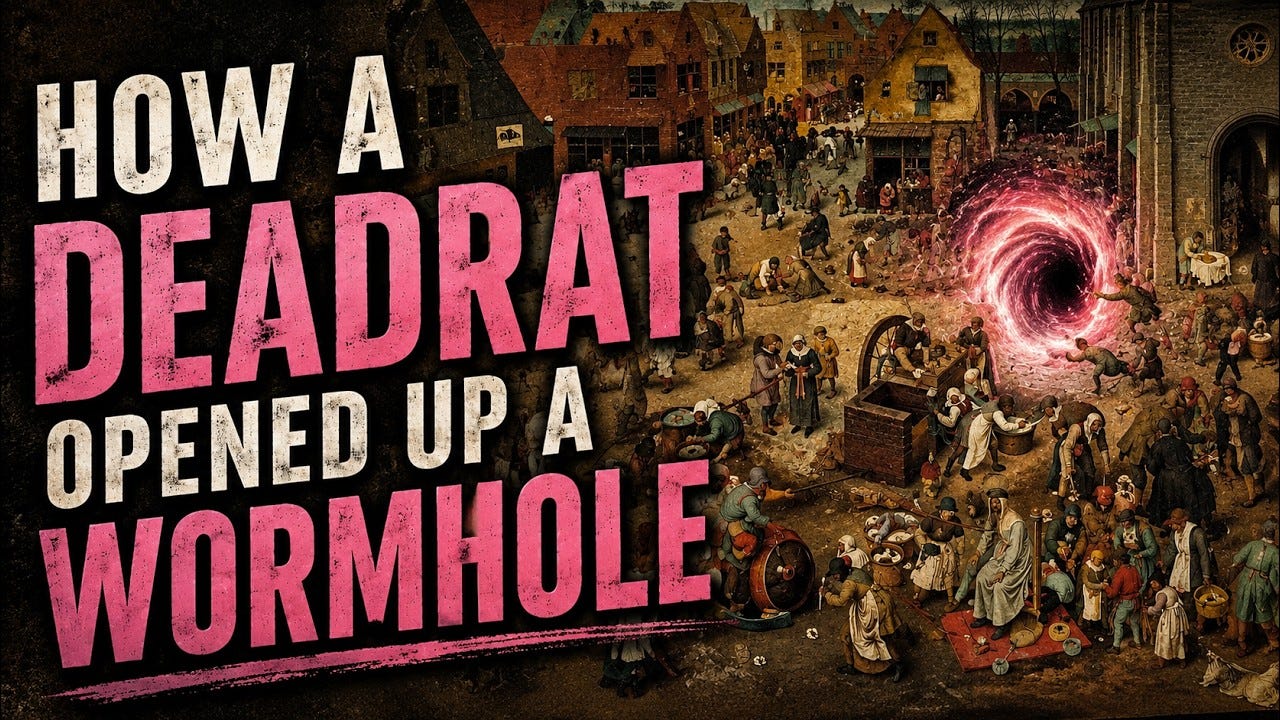
I Found a Dead Rat. It Led Me Into the Sixteenth Century.
The Story
Welcome to the podcast!! Unadulterated pure European hardcore history baby!! That and stories from my life as a travelling street musician.
Find me on YouTube => Kobi One Podcast
Show your support with buying me a coffee.
https://buymeacoffee.com/kobecooman3
This is a public episode. If you'd like to discuss this with other subscribers or get access to bonus episodes, visit kobione.substack.com/subscribe
Nothing alive had any business smelling this bad. Rats. Somewhere in a wall cavity, a rat had died. It could have had the common decency of dying somewhere in plain sight, but I shan't complain overly much. At least it had had the decency of not bothering us when it was still alive. But... It was clearly no longer alive. For a week we fought the stench best we could. Candles, oils, incense, ventilation. Nothing worked perfectly but it all helped a bit. During one of these smelly days it hit me like a freight train.
If I have spent a week in odour hell because of one dead rat, what insane amounts of sensory assault did people deal with in the Middle Ages? If you know me by now, simply wondering about it wasn't enough. Fair warning though, better light that incense prematurely.
The 16th century was a century of movement, a century of expansion, a century that felt like it had the future in hand. One hand, hopefully. It would need a free hand for holding a mob, because with the expansion came people. A lot of people. The discovery of America brought with it an entire new frontier. New inventions, exotic wildlife and literal new trade routes that came with the discovery created totally new markets. Spanish galleons crossed the Atlantic carrying silver, spices, pepper and gold.
Each voyage brought substantial tonnage. Official figures claim about 17,000 ton of silver was imported from America in the 16th century alone. Double that to account for smuggling. All that trade, gold and silver brought massive wealth and expansion to the cities of medieval Europe. A population bomb went off and the shrapnel lingered mostly in cities such as Ghent or Antwerp.
An Italian contemporary man named Guisiardini describes cities in Flanders and Brabant as extraordinarily dense and wealthy compared to the rest of Europe. Half of the Flemish population lived in cities like Antwerp, which counted already 200,000 inhabitants by the late 16th century. A massive number surpassed by very few cities back then.
And with the wealth came the inequality. You know how this goes. The massive influx in silver and gold reduced the currencies of the day in value by an incredible amount. Inflation is real and it's not cool. In the time span of one century, the European currencies inflated on average with 700%.
That is ridiculous. I consider the picture now fully painted. The cities had no infrastructure or room to accommodate the massive influx of people now flowing in. And a lot of these people that flocked to the cities. Well, widely spread, but wildly probably as well. Death was an entity often stared directly in the face, or rather propelled directly into the nostrils.
Only the better off lived on cobblestone streets. The poor, they dwelled in the mud. Carcasses filled with flies from street butchers, unburied bodies with maggots crawling out. Free-roaming farm animals, pests and rodents. Assorted leftover liquids from brewers and tanners alike. All of it culminating in muddied streets that were almost impossible to pass when wet. And it was often wet. Wet and smelly. The smell was so outrageous that when the Black Plague hit, people were convinced the plague was carried by the bad air.
The war on stench was a war often lost. Ventilation and air currents were scarce. People would burn herbs or carry them in bundles around their neck, directly under their noses in an attempt to block the smell. Against the smell, it would help some. Against the plague, not as much. If the bodies and cadavers were bad in normal circumstances, during fits of the plague, bodies were hastily buried, often undeep. Rotten stench and creepy crawlies would be thirteen and a dozen. Even the churches were no safe havens.
We believed getting buried closer to the holy ground of the church would help us get more easily into heaven. The richest, well the richest, they were often buried under the floorboards of the church, where you could smell their decaying corpses through the floor. Stinking rich they were.
If you wandered far enough away from the densely packed city streets and their street vendors, fishwives, families of humans and animals alike, you would inevitably pass the crossroads or sometimes entire fields filled with the broken and mutilated bodies of bandits and crooks hanging off of the very wheels used to break their bodies. Justice was delivered black or white. Guilty or not guilty. By judges with absolute power. Let's just say you did not want to be found guilty. The judges operated on pure discretion.
No fixed code, no consistent scale. The same crime could get you branded, banished, or executed, depending on who was sitting in judgment that day. A contemporary writer described the gallows structured along German roads with heavy irony as fine wooden houses with crane beams. They were everywhere. Not just at city gates, along roads, at crossroads, in fields, permanent furniture.
And if you happened to be foreign during, for instance, a plague outbreak, your odds got considerably worse. Jewish communities were systematically scapegoated when plague hit cities.
A Dutch humanist of the time. He documented regional groups blaming each other. Walloons, Flemish, English, Scots. Each convinced the other had brought the sickness. Somebody always had to carry the blame. And why blame the powerful? When there were plenty of those that had no means to defend themselves.
So, with all of that filth and muck and human waste, it was no wonder they drank so much beer in the Middle Ages. The water must have been real shitty, right? Wrong! City councils, like the one in Ghent, went to great lengths and spent quite some effort to keep the water supply as clean as they could. They depended on the water. It was their life blood. The myth that everybody was pooping and peeing in the water simply isn't accurate. For instance, poop and piss were valuable commodities. In urine, there is ammonium.
This is a very handy dandy chemical indeed. It was used for bleaching wool and cotton and it was used for tanning leather. Throwing away valuable urine in the same water you would afterward drink sounds as ridiculous as it is. It happened way less than you might think. Second... Cities issued ordinances specifically to protect water quality. Things like butchers who were often required to move slaughter operations outside city gates. In Rotterdam, the Netherlands, there it was mandated that waste go into deep ditches rather than streets so it wouldn't end up in the water.
Moreover, in Ghent, we have a long-standing relationship with the water that surrounds us. We tamed it as much as it tamed us. The city is even named after the two rivers that flow through it, the Leie and the Schelde, culminating into a confluence once named the Ganda, Ghent.
We built waterlogs all over. Every two weeks we would do a coordinated flush. We would open up all the water locks at roundabout the same time and then send all the dirty water downstream towards the Netherlands. Let them deal with it. Fresh water would be let in from the source upstream, France, at the same time. The brewers would go scooping up as much as they could for the beer and everyone else for personal use. So, if we had plentiful drinking water, were we just drunkards without a cause? Not quite.
Problem was, we had no food. The rich of the day considered a healthy meal to consist out of meat and wine. The poor lived off of turnips, onions and cabbages. A lot of smelly farts, yes, but not a lot of full bellies. We were hungry. Beer was our liquid bread. Food for the masses. We drank mainly table beer of little alcoholic content but rich in fermented grains and hops that had vitamins, fiber and starch. So, which diet would you have preferred? Beer, stale bread and soup of turnips and onions or mutton with boar and a side of chicken served with red wine?
If you were rich enough, you might even have scored an Italian red. Wait, how do you say red wine in Italian?
So the world grew bigger and the people grew more numerous. The expansion of trade and empire opened up the world beyond the borders more than ever before. Traders of all kind, traveling pilgrims spreading the faith and country boys and girls from as early as their teens set out to see the world and explore. Travel was possible, though at times almost impossibly slow. On foot, you could do at best 25 kilometers a day if you didn't get lost. And it would be hard not to get lost. To make matters easier for all, the Endeavorous set out to make maps and books.
And all was well. Well, kind of. All was at least slightly better. The cartographer, Martin Waldseemüller, had already made his Carta Itinario Europae in 1511, which supposedly mapped all main European trade routes. French Charles Estienne had already published his La Guide des Chemins de France, The Guide of French Roads, in 1552, which is the official first travel guide for France. But this did not mean travel or navigation was easy now. Seeing as they were the first of their kind, these travel guides, the men making them had only information from locals to go by.
There were plentiful mistakes to lead a traveler astray. Not to mention all the roads that had been actually accurately mapped, but had already vanished due to lack of maintenance or heavy rain. Whenever the roads had led you astray, well... You could always reach for your travel guide to spell out some easy conversational sentences to get by with. One of the world's first and funniest was written by John Florio, an Englishman with an Italian father. His book First Fruits... Was published in 1578 and intended to help the average Italian trader find his way in England.
It reads as very helpful indeed. On help for finding the road he proffers this helpful sentence. I have loved you, I love you and I will love you. I will break my fast with you. We will have a pair of sausages. Well, at least breakfast on sausages does sound very British. No idea how this would help you find the way, though. The person you said it to might tell you to get lost, but the joke would be on them because you already are. With some luck, though, you would eventually find your way to an inn or tavern where you could have some ale, some soup and a bed for the night.
Travel would be slow. More Comfortable.
Speaking of uncomfortable, people who could afford an inn but traveled alone had a great big chance of having to share a bed with another person of origin unknown. Here, too, a guide would come in handy. Though one might better not use John Florio's first fruits for guidance here, or nightly adventures might be had, unwillingly. The wealthy in their turn had sufficient funds for staying in monasteries, churches, or simply bringing their own beds and cooks along with them. Erasmus, a famous Dutch humanist of the time, has chronicled his passage through Germany, for instance.
There he speaks of inns where 80 to 90 people would be stowed away. The rich and the poor together, innocent. Entire families even. People spitting on the floors. The in-smelling of garlic and sweat and dank humanity. Everybody using the same bowl of soup to dip their bread in. The beds were disgusting and covered with pus and hard bits and things better left unnamed. People drinking wine of dubious quality and every newcomer gets treated to the old hush and stare. If you wanted to travel, you had some serious sacrifices to make.
So... But...
Then I stumbled into my favorite century again, the 16th, and all was not entirely as I imagined. Death and stench were man's constant companions, or, more accurately, constant foes.
These were people like you and me and they made it work as well as they could. They might not have wanted my compassion or needed it. They found ways to get by. One of those ways was an all-time golden favorite that a lot of people still use to make life more tolerable. Beer. We may have escaped the smell, but we still find reasons for brewing ale all the same. I personally prefer mine alcohol-poor, just like in the olden days. Now, what say ye? Give us our daily bread. See you in the next time.
Kobi One, signing off. Take care.
 Apple Podcasts
 Castbox
 Castro
 Goodpods
 Moon FM
 Overcast
 Pocket Casts
 Podbean
 Podcast Addict
 Podcast Republic
 Spotify