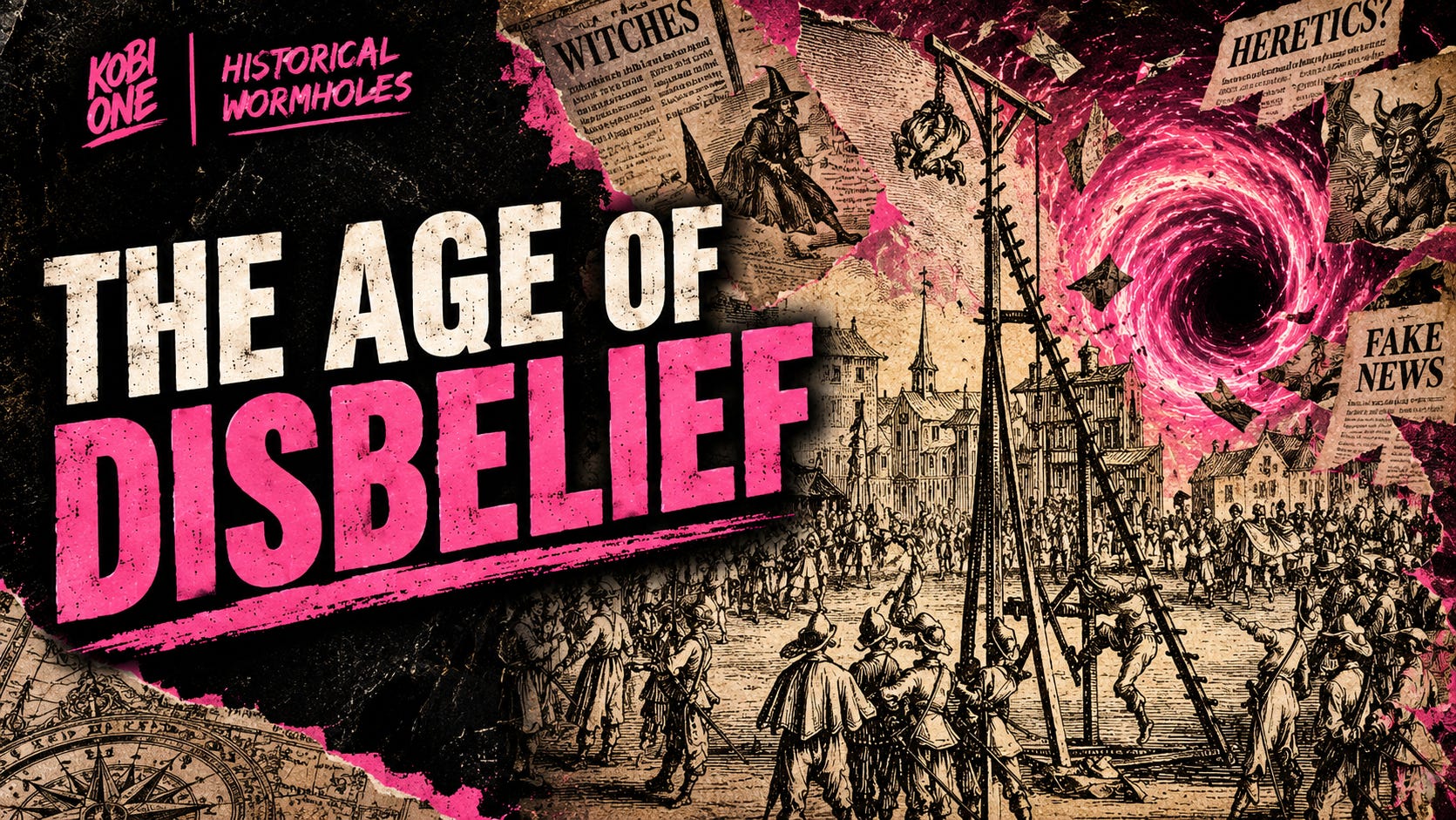
The Age of Disbelief
The Story
How does misinformation travel?
From the witch trials of Arras in 1460 to town criers, carrier pigeons, the first postal networks, Gutenberg’s printing press, and the infamous War of the Worlds “panic,” this episode follows the history of information as it gets faster, reaches further, and becomes harder to control.
Because the problem was never simply that people lied. It was how information changed as it travelled.
And now we’ve handed that process to algorithms.
Are we entering an age where misinformation can fool everyone, or one where nobody believes anything anymore?
🎙️ Kobi One Podcast — history meant to not be boring.
☕ If you enjoy the work, you can support the podcast: https://buymeacoffee.com/kobecooman3
📚 Read the full article:https://substack.com/@kobione
▶️ Watch the podcast on YouTube: https://www.youtube.com/@KobiOne6969/featured
This is a public episode. If you'd like to discuss this with other subscribers or get access to bonus episodes, visit kobione.substack.com/subscribe
The panic had given way to true horror and gripped the entire city, if not all of the kingdom.
There were witches infesting our villages, our cities. They could be anyone, anywhere, but no more. We were going to find every single one of them, whatever it took. And after we found him, one person after another would break and eventually admit to either being a witch or knowing of them. We simply followed the trail, however bloody. Most of those we interrogate would tell us what we needed to know quickly. But not this filthy witch. Huguet Aymery, the barber. Seven times we broke his body with a brodequin, and it had given us blood, screams, and scenes that would haunt me well into the afterlife, though I would never admit to that in public.
Blood and screams, but no information, nothing, zilch. We started out with the regular Brodequin, fixing his legs between four planks. Each leg had one plank on each side. And they were all strung tightly together with cords. Then four wedges would be hammered into whatever openings remained between leg and plank, raising the pressure with each hit of the hammer. Aimerie would cry, beg and scream. He would plead. He would whimper. He would not confess.
We even upgraded to eight wedges. From the sixth onwards, you could hear the crunch and crack of his bones, slowly crushing under the formidable pressure. Still, he gave us nothing. The seventh time we used the Brodequin, after they wedge the eighth piece of wood between flesh and plank, Aimeri blacks out, before he can admit to anything or name any names. When he wakes up, he's blindfolded, bound and on a horse, moving. We tell him, We are taking him to his beheading. He shits himself some more.
Still, he does not confess. Lucifer must be giving this one extraordinary powers. To the Strapado with him then. Come on, in God's name. We hang him up there eight times. Every time gets more brutal. The last two times we even add weights to his legs and we hear his shoulders dislocate and slowly rip out of their sockets. We scream at him until he is covered in our spit. Who are the others? Why did you choose the devil? How do you communicate with your master? Are you a witch?
Nothing. He gives us nothing. We could break his body, and Lord knows we did, but we couldn't break his will. The others are bound to tell us something. We will find these witches and rid our cities of this plague. They will all burn.
Hi, welcome to the channel. I'm Kobi One and if you like history and don't mind it getting bloody sometimes, make sure to follow or subscribe and punch that like button on your way if you can. Now, let's get into the rest.
Five people end up being burned alive as a result of the interrogations you just heard.
In the city of Arra, on the 9th of May, 1460. Aymiri, the man you just, well, you just met in a quite bloody way, he's not one of them, though he gets imprisoned to live on bread and water alone for twenty years. The charge? Having had, at a certain point in time, escaped custody. So, for trying to escape these insane interrogations founded on absolutely nothing, he spends twenty years in jail. Somewhere, in the hearts of man, the uncertainty of the changing times, the black death, the wars, it had all taken root and it had transformed into an all-encompassing fear for the devil.
And his accomplices. Our story actually starts outside of Arras entirely. In 1459, a hermit named Robinette de Vaux was under interrogation for heresy at a Dominican gathering in Langres. Those damn Dominicans, well they earned themselves the nickname, the Hounds of the Lord. Domini, that's God, and Canis is dog, so literally Domini, Canis, the dogs of God. They weren't very nice people. Under pressure, Robinet named two people from the Ara region as witches, even though there was no real connection between his own case and that town.
And if you don't know about Ara just yet, Ara Atrecht, we can also call it. It's Border France and the Low Countries. And there's a nice podcast about it down in the links below. The inquisitor Pierre Le Broussard, he was present during all of these interrogations and the names that were named, he carried those two Arras with him. The first person taken was Deniselle Grenier, a prostitute. She was arrested on the 1st of November 1459 in Douailles.
Under torture, she did what the system was designed to make people do. She confessed and she named others. She described a night gathering and a master of ceremonies. And she put a name to that role too. The man she pointed at was the wandering poet, painter and performer nicknamed the Abbot of Folly. Sources actually disagree what his real name was. Some say Jean Lavite, others Jean Tennois. He was captured at Abbeville on the 25th of February, 1460. And then afterwards he was brought to Arras.
Now he was in the same chair that the prostitute Denizel Grenier had been in. He too was being tortured and he too ended up confessing. And this is the turning point of the whole story. His confession did not stay small. He named people of all estates, meaning nobles, clerics, ordinary townspeople alike. Up to then, the accusations, well, they only touched the margins, the people living on the margins, a prostitute here, a vagrant performer there, but now the witch craze grew beyond its marginal borders.
Once the poets started talking, the net reached the higher echelons of medieval Europe as well. A fresh wave of arrests washed over the city, Arrastil, the same city, in February and March 1460. And by then, eight people sat in the church's prison. One of them was Huguet Améry, the bishop's former barber. He had no link to Grenier or the poet whatsoever. He was there only because a name had been given up under torture. This was the system. Inflict pain on those named until they name more. The machine ran its course.
On the 9th of May, 1460, in the courtyard of the Bishop's Palace, before a large crowd, the clerics ruled on seven of the accused. Five women and the poet were sentenced along with the corpse of a man named Jean Lefebvre. He had hanged himself in his cell. Each condemned person wore a paper mitre, like a hat of sorts, painted with an image of themselves paying homage to the devil. What sense of drama. Le Borossard delivered a speech describing the imagined rights in vivid detail, and the sentences were pronounced.
All of the property was seized and the accused burned. Aymery was not among them, because he had never confessed. The system was as crooked as can be, but it needed a confession to condemn him. The fear fermented, and it became a negative feedback loop. Everything proved what everyone already believed and anyone could be part of the conspiracy. People started avoiding the city of Arra entirely, trade went down, businesses lost money and the imagined witch craze became a real-life economic and social disaster.
A decade and change later, Louis XI would come to Arra and try to wipe it off of the face of the planet. More on that via that link in the description. 31 years later, the Parlement de Paris finally admitted to what had happened. What they had let happen. They annulled the sentences and ordered the trial records be burned. As if burning the paperwork could erase the burning of the innocent. It changed nothing for the dead And it did nothing to stop what was still coming. The story of Ara is one of information, really, and how easily its flow can be corrupted with possible disastrous reverberations such as the mass burning of innocent people.
To understand how a population can be led that far astray by something that was... At its core, misinformation. We first need to understand how information travels through the ages.
Before there were computers, internet or cables connecting the world and well before deepfakes already muddied doze waters Information, if you believe it or not, was already spread. For the longest of times, from old Rome till the advent of modern times, we relied on town criers, oral messengers and post pigeons to relate to us the information of the day. Town criers and oral messengers were taken very serious and aggression towards them was not at all tolerated. They were in protection of the law and especially in the middle ages.
You did not want to get on the wrong side of the law, in case you forgot my introduction. Town criers and oral messengers were of course the norm. Seeing as for a long time only the upper echelons of society knew how to read. So paper messages were reserved for the wealthy and the powerful. Messages relayed to town criers and oral messengers had the highest potential of distortions. Because the discretion of the message was wholly up to the person in charge to both remember and eloquently pass on.
I can think of many ways this can go wrong. Post pigeons were genuinely awesome and their messages were very difficult to distort. Thing is, they took a lot of time to set up. You had to train the pigeons and train them well. Soon as they were trained, well, you were good to go but they only had one route. You could send a message to one place, always the same place for the same pigeon. So you basically had to decide in advance where letters would probably need sending towards. Quickly, send word to Engelbert, he needs to know.
Sorry, sire, we used the pigeon for Engelbert yesterday to verify you had indeed won that round of chess last time. Blast it, then send word to his brother. We can't, sir, he suffers from ornithophobia. He's ill? No, sir, he's afraid of birds, sir. What does that have to do with anything? We never managed to train a pigeon to fly to his castle, sir, seeing as he has all birds within range of an arrow shot on the spot. Dang it all to heck! God have mercy! See, all of that couldn't have been very practical.
Not to mention all the bird poop. There must be a better way. A man named Detasso seemed to agree.
Francesco de Tasso was the courier and postman who handled the marriage negotiations of Juana la Loca and Philip the Handsome in 1496.
The stars of many episodes already. Though he worked for his father, Maximilian, it was the son, Philip, who made de Tasso and his postal service officially available to the public. Becoming the first public postal service. Detasso received a yearly wage of 12,000 pounds from the Burgundian Duke for his services. But his costs ran high. And since Maximilian was often slow or totally unreliable in paying what he owed, Detasso also took on other postal contracts to cover the gap, to cover the costs.
Eventually extending his service to Zeeland, Portugal and Calais as well. Basically, de Tasso established the world's first postal network out of necessity because his boss kept not paying him timely. Under this network, by the mid-16th century, couriers could cover Brussels to Paris in 36 hours and Brussels to Naples in 14 days. The de Tasso family held the monopoly on international post for three centuries, off the back of this arrangement. Not bad, eh? However impressive, And expansive the network was, it was still quite limited in mostly its reach.
It was a one person to another type of thing. And every method we've just walked through, a crier's memory, a bird's single fixed route, a courier's physical horse, they all ran through one fallible human link. And as you may recall from the intro, one man giving one false testimony under interrogations could lead to many people burning. Heavy repercussions for a one person to another type of thing, wouldn't you say? So what happens when one person can reach hundreds or thousands? Let's find out.
[music] As Gutenberg's printing press was invented around 1450, information stopped traveling through a single, fallible human being each time. Now, one version of a text produces thousands of identical physical copies, all saying exactly the same thing, with no human relay step able to alter it in transit. This did not mean misinformation was now utterly prevented. Distortion of the message itself through the human game of telephone, this was indeed cut out of the mix. But if the message itself contained wrong information, purposefully yay or nay, it was now solidified, amplified and given an air of respectability it before had not.
The written word carries a weight, a magic with it, that mere spoken words could never muster. People can be caught under its spell. This was never more obvious than with the first bestseller the printing press produced, the Maleus Maleficarum, i.e. the Hammer of Witches.
The book was written by Heinrich Kramer and first published in April 1487 at Peter Drach's Press in Speyer, roughly 50 years after Gutenberg's Press existed and 27 years after the witch burning in Arras. It's been argued to be one of the most important single factors driving the witch craze and persecution of women across the late 15th and early 16th centuries. That, to me, seems to be giving it a bit too much credit seeing as by then people had already ended up on the stake. The book came out 27 years after the witch burning we just spoke of.
Well, what Print did was take that already working machine and mass produce it. Mass produce the actual instruction manual. Standardize it and then ship it everywhere at once. And even though the book was published some years before the official annulment of the witch trials in Erra, it still spread like wildfire afterwards. The official annulment of the trials by the Parlement de Paris did nothing to prevent a mass spreading of the misinformation. Nothing. Six editions came out in the 15th century alone.
Twenty more editions followed by 1520.
Bringing the total circulating copies to roughly 20,000 by that point. Only 70 years after the actual invention of the printing press. So, arguably, this was history's first true bestseller in the modern sense. One text, mechanically reproduced, identical in every copy, reaching readers across the continent. Well... There were still drawbacks, of course. Not everybody had the skills required to read or the money to buy books. Also, you still had to physically make the books, which required more skill, resources, money and time.
The scale had moved up considerably, but time and space still got in the way. They still needed to be traversed. If only... We could have information move faster than the horses themselves. [music]
With the advent of radio, both the scale and the speed of information went up. And it went up a lot. But that is hardly all that's changed. With the added speed came a sense of urgency, a sense of a shared now that had never existed before. Information could be relayed to the other side of the continent at breakneck speed riding the radio waves. Messengers and written messages were clearly information from the past, brought to you now. The separate nows didn't sync up. It might have been information of a coming event, but it always came at you from the past, from a person in that distant past.
With the radio, that changed forever. This was a person that seemingly inhabited the same now, and you heard him or her directly in your own living room. Someone was, right now, relaying information to you Instead of from the past. And that directly into your own home. Exactly like an oral messenger but then at incredible scale and speed. World shaking. No skills were required. You just needed to be able to hear and understand the language spoken. The sky was the limit. History's favorite example of where this newfound technology and its usage thereof could go awry was Orson Welles and his radio broadcast version of The War of the Worlds.
An excellent example of misinformation indeed. On the evening of the 30th of October 1938, a 23-year-old Orson Welles and his Mercury Theater on the air staged H.G. Welles' War of the Worlds as a live CBS broadcast dressed up as real-time news bulletins.
A Martian invasion of New Jersey was Reported the way an actual night of breaking news would sound. The show, well, it opened with a disclaimer saying, hey guys, this is all fiction. But it then ran almost commercial free for the entire first stretch. So anyone dropped in halfway, anyone who missed those first 30 or 60 seconds, they had no idea they tuned into a play. Most people have heard of this story one way or another. I personally even learned about it at school. The live-performed radio theater that shook the world and sent all of America into an outright panic, a frenzy, almost at the brink of war, I say.
Well, it seems this event never happened, or at least not in that way. The radio show did, just the ensuing panic and wartime scenarios we all heard of, those never did. The night the show aired, a ratings service was called, and 5,000 households were called to ask what they were listening to. Only 2% named the Welles' show. It was going up against the most popular program on American radio that same hour. Investigators later checked hospitals and police records for that night and they found no confirmed panic deaths, no confirmed hospitalizations, none of the hysteria that the story we know describes.
So where then did the myth come from? The next morning, papers ran it as listeners from the radio, radio listeners, in panic and radio fake scares nation, stuff like that. Radio has spent the depression quietly stealing newspaper ad revenue. Radio wasn't being too good for the newspapers. And now this, this was too good of a chance to pass up. Let's paint that new medium as reckless and untrustworthy, right in front of advertisers and regulators. Newspapers wrote nearly 13,000 articles about the supposed panic over the following month.
Then... Two years later, a Princeton psychologist published a study claiming a million Americans had been genuinely terrified, giving the myth a stamp of academic respectability, even though his own numbers didn't hold up to later scrutiny. Then... The show's own producer wrote an essay, a decade after all of it, claiming indeed millions had panicked, which did this specific producer of course no harm at all. So the actual misinformation event here isn't a radio broadcast. It's the story about the radio broadcast.
A panic that barely happened got turned into a panic that definitely happened by the industry that had the most financial motive, laundered through a university where it got its respectability and then just repeated by everybody, including me, up until just now. The written word has won the war of the misinformation from the radio it seems. [music]
With town criers there was a whole crowd listening. The information did not exist nor was it delivered into a vacuum. There was a whole world around it, to give it context, to give it a sounding board. And still, misinformation creeped in easily, stealthily, at every junction, every turn, the information took. Each retelling, potentially damaging the original message. When consuming information through reading books, the context is given by the book itself. You can't ask the book a question and then have it magically hand the answer over to you.
You need to read a bunch of stuff that you don't need to know before you get what you wanted to know. And by the time you get there, you will have been given more context, more knowledge than you had before. You will be able to make more connections between seemingly unconnected things. You might never have understood the answer as fully if it wasn't for the context it now existed within. And still, books and the written word have shown time and time again To add weight and respectability to inane and insane ideas and then amplify the spread of that misinformation.
Now take everything that just went wrong within the flow of information and give that to an algorithm with no editor, no newspaper rival trying to discredit it, no delay at all. TikTok videos run three minutes at the absolute outside, most under 45 seconds. That's not enough time to make an argument, it's barely enough time to make a claim. A confident face, a bold statement, a cut before anyone can ask a follow-up question, and you're already three videos further into your scroll. The videos exist totally context free and they are tailored to grab your specific attention for as long as possible without having any moral obligation to teach you anything along the way.
A contextless medium that has completely bridged the distribution gap. A crier needed a crowd together. A pigeon needed a trained route. De Tasso needed roads and horses and three centuries to build a monopoly. The printing press needed a printer, paper, physical transport. TikTok's For You page needs none of that. One video. If the algorithm decides it's engaging enough, one video can reach millions of strangers within hours. No audience required, no gatekeeper to get past, no context. Researchers studying the platform during the invasion of Ukraine found misleading content in close to one in five videos the platform's own search function surfaced.
The negative feedback loop described in the intro happened at a societal level, a slow build with horrible repercussions. What I am describing here leads to another beast entirely. The more misinformation a person engages with, the more of it they get shown next. The algorithm, it isn't trying to inform you or deceive you, just keeps trying to give you what you watch. And it turns out fear and outrage are very good at exactly that. Which means the machine that once needed a confession or an acquisitor, well, it now does everything automatically, for anyone, all the time, without a single person having to lift a finger or tell a single lie on purpose.
Anybody can make a video of anybody. Saying anything at all really. And that could potentially be spread to millions because of no other reason than it capturing people's attention. Anything can be faked. And I feel the generations growing up today, they are actually very much aware of this. It makes me wonder. Will we all be easily fooled by the next gen of misinformation or are we entering an age of disbelief? When we no longer believe anything, will we still have anything left to believe in?
Well, I'll leave you at that question, ladies and gentlemen. This was Kobi One and, well, quite a weird little travel through misinformation. Hope you're better informed now. Take care. See you in the next one. [music]
 Apple Podcasts
 Castbox
 Castro
 Goodpods
 Moon FM
 Overcast
 Pocket Casts
 Podbean
 Podcast Addict
 Podcast Republic
 Spotify